
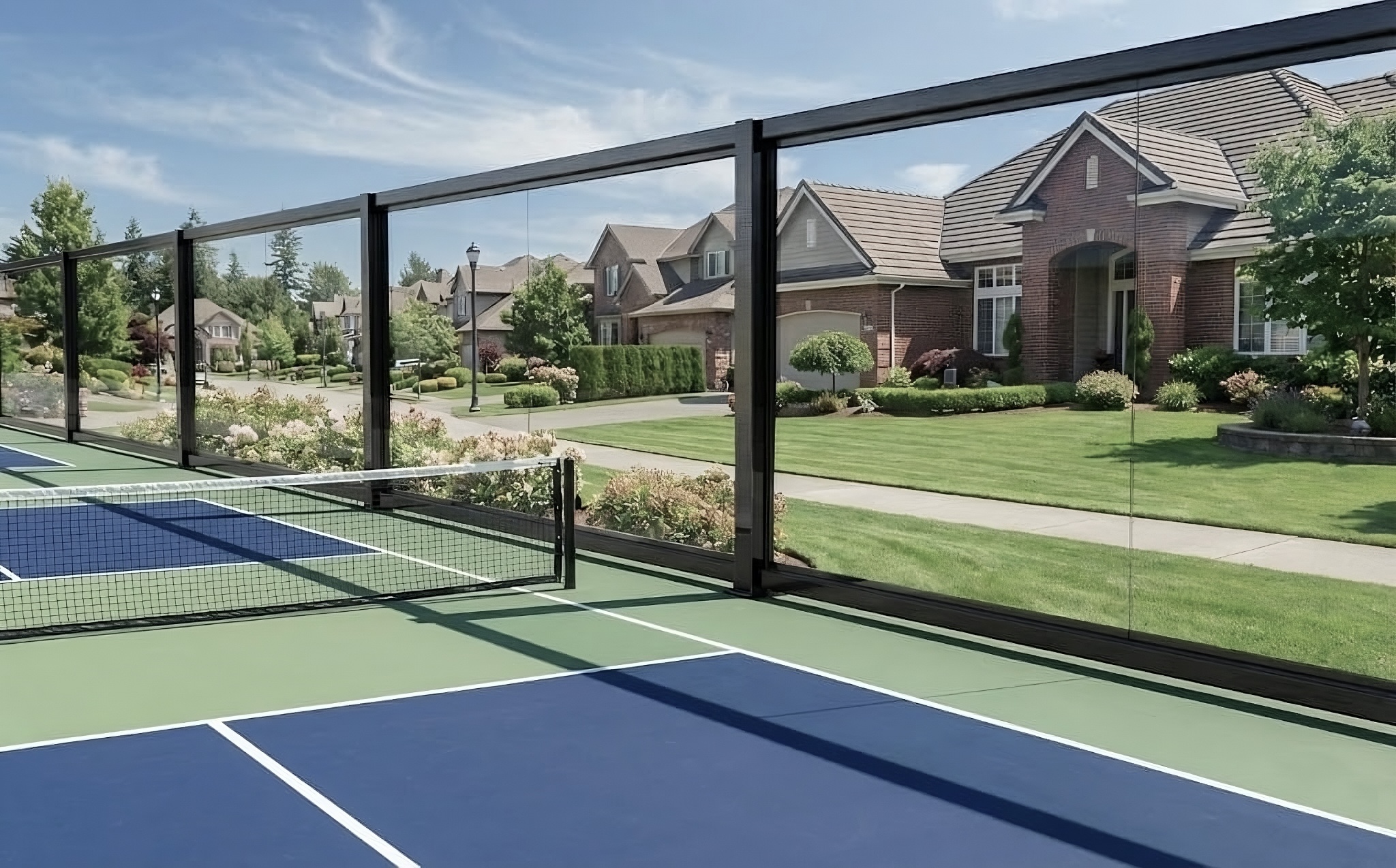
The board sees two numbers at the start of a cost comparison — the number that matters is what each option costs to own across fifteen years of club operation.
AUSTIN, Texas – May 16, 2026 – When a club board evaluates a court project, the conversation almost always starts with the upfront number. A chain-link bid comes in at one price. An engineered facility comes in at a higher price. The board compares the two numbers and asks why there is a gap.
The gap is real. But the comparison is incomplete. When the evaluation extends to what the facility costs to own, maintain, and operate over 15 to 20 years, the picture changes significantly. And when the evaluation also extends to what each option looks like to members across that same span, the picture shifts again.
This article is about the financial comparison the GM needs to bring to the board. It is also about the day-to-day reality the Director of Racquets is living during every one of those 15 years. The two views are tracking the same facility from different angles, and both ultimately argue for the same answer.

The chain-link maintenance cycle
Chain-link enclosures with windscreens follow a predictable maintenance pattern that the Director sees coming year over year.
Years 1 to 3. The installation looks acceptable. Windscreens are intact. The vinyl coating on the chain-link is holding up. Maintenance costs are low. Members are not commenting on the facility’s appearance because it still looks new.
Years 3 to 5. Windscreens begin deteriorating from UV exposure and weather. They tear, fade, and sag. Replacement runs $2,000 to $5,000 per cycle depending on facility size. The vinyl coating on the chain-link begins breaking down, and rust starts appearing at connection points, posts, and the base of the fence. The Director starts patching torn windscreens between member events and scheduling replacements ahead of tournament weekends. Member comments shift from “this looks good” to “is this getting replaced soon?”
Years 5 to 8. Rust becomes more visible and structural. Fabric sections begin sagging or separating from the frame. The windscreens have been replaced at least once, possibly twice. The overall appearance has noticeably deteriorated. Members are commenting more frequently. The club begins patching sections rather than replacing the entire system. The Director is fielding questions at every member event about when the facility will be updated.
Years 8 to 12. The enclosure is approaching the end of its effective life. Rust is structural in multiple locations. Fabric replacement is no longer cost-effective because the frame itself is compromised. The club faces a decision: invest in a full replacement at current prices (which are higher than the original installation was) or continue patching a system that is visibly past its service life. Members are comparing the club’s courts unfavorably to clubs that have upgraded. New members touring the club ask about the racquet facility and get an answer that does not match the rest of what the club represents.
During this entire cycle, the chain-link system provides zero acoustic benefit. If noise becomes an issue at any point along the way, the club must address it separately, at additional cost, as a completely independent project that the board did not budget for.
The engineered facility maintenance profile
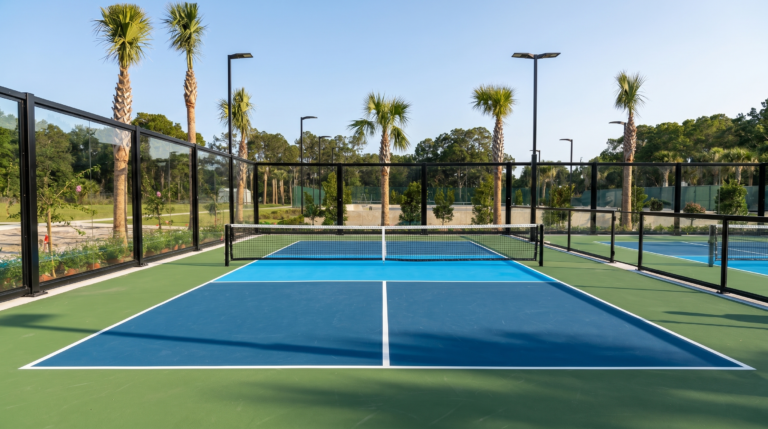
A PICKLEGLASS™ structural glass system on a post-tensioned concrete slab follows a different pattern, both financially and visually.
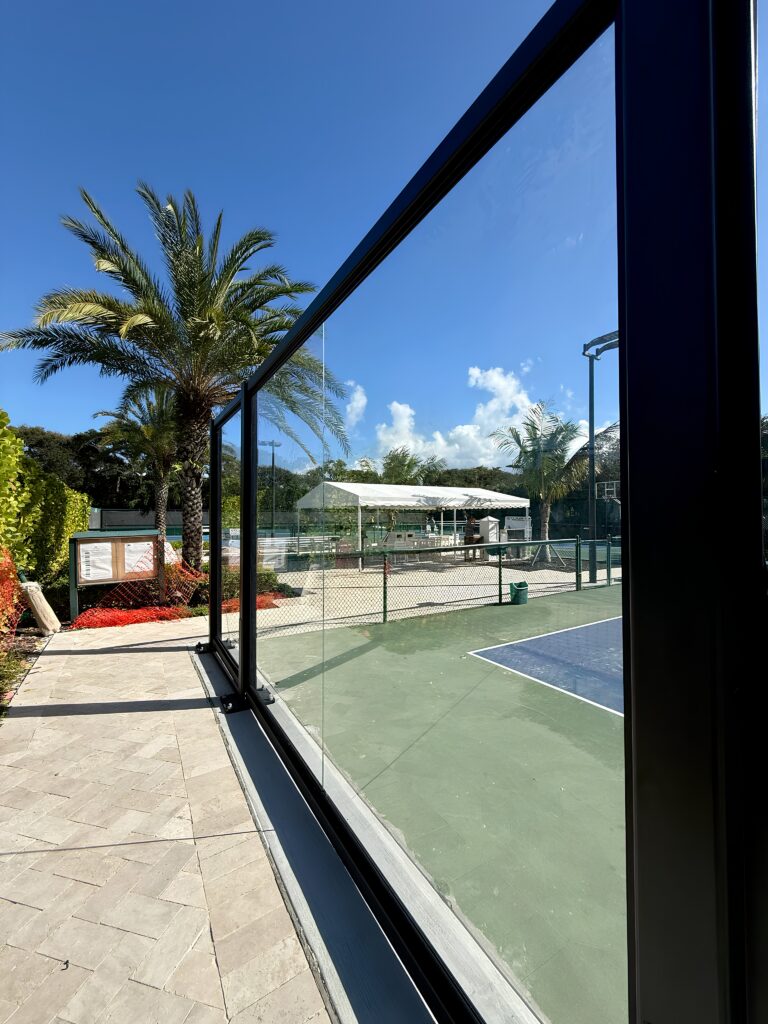
Years 1 to 10. The EnduroShield coating on the glass panels repels contaminants. Rain provides most of the cleaning. The powder coat steel finish is backed by a 10-year warranty against rust and corrosion. LED fixtures carry a 5-year warranty. The facilities team’s involvement is minimal. There are no windscreens to replace, no fabric to patch, no rust to treat. The Director is not fielding questions about the facility’s appearance because the facility still looks like it did the day it opened.
Years 10 to 15 and beyond. The steel frame continues performing because the corrosion warranty period was designed with significant margin beyond the warranty itself. The glass panels have no degradation mechanism. Tempered glass does not wear out from weather exposure. The court surface may need recoating in the 8-to-12-year range, which is a maintenance event on the surface only and is the same regardless of the enclosure type.
The acoustic performance stays constant throughout. STC 36 on day one, STC 36 on year 15. There is no degradation of the acoustic benefit over time because the glass and steel do not change their physical properties. The Director’s programming hours in year 12 are the same programming hours the Director had in year 1.
The total cost picture
When the chain-link replacement cycles, windscreen replacements, rust repairs, and the potential cost of acoustic retrofit are added to the lower upfront number, the lifecycle cost gap between chain-link and engineered glass narrows significantly over 15 years and frequently reverses over 20.
Meanwhile, the quality gap never narrows. The engineered facility looks, performs, and represents the club at the same standard in year 12 as it does in year 1. The chain-link system looks like a chain-link system from day one and looks worse every year after. The Director’s experience of the two systems is not comparable. One is a facility they can show prospective members proudly throughout its life. The other is a facility they have to explain.
What this means for the board conversation
If the board is evaluating the court project purely on upfront cost, the chain-link bid will always look better. The number on the page is smaller. The decision feels easier.
If the board is evaluating the project on total cost of ownership, member experience, club positioning, and long-term facility performance, the picture is very different. The same dollars produce a 15-year asset on one side and a 5-to-8-year asset on the other, with a series of capital re-approvals required to keep the cheaper option in service. Boards rarely choose to revisit the same capital decision multiple times once they understand the alternative.
For the GM, the most useful framing for the board is the question itself: what does each option cost to own across the expected life of the facility, and what does each option deliver in member experience and club positioning during that time? When both sides of that equation are on the table, the case becomes clearer to people who were not predisposed to it.
For the Director participating in or supporting the board conversation, the contribution is the operational picture: what the facility looks like to members in year five, year eight, year twelve. The board members are not visiting the courts every week. The Director is. That perspective, presented alongside the financial framing, often does more to settle the conversation than any number on its own.
If you would like a lifecycle comparison tailored to your specific project scope, that is part of what the scoping conversation covers. Happy to set it up whenever works.
About PICKLETILE™
PICKLETILE™ is the leading design-build firm for premium pickleball court construction and the Official Court Builder of USA Pickleball.
Headquartered in Austin, Texas, PICKLETILE™ simplifies the complex construction process by offering turnkey solutions for residential, commercial, and club-level projects. The company is also the creator of PICKLEGLASS™, a patented soundproof glass wall system engineered to reduce noise by 50% while offering panoramic views and wind protection. For more information, visit www.pickletile.com.
