
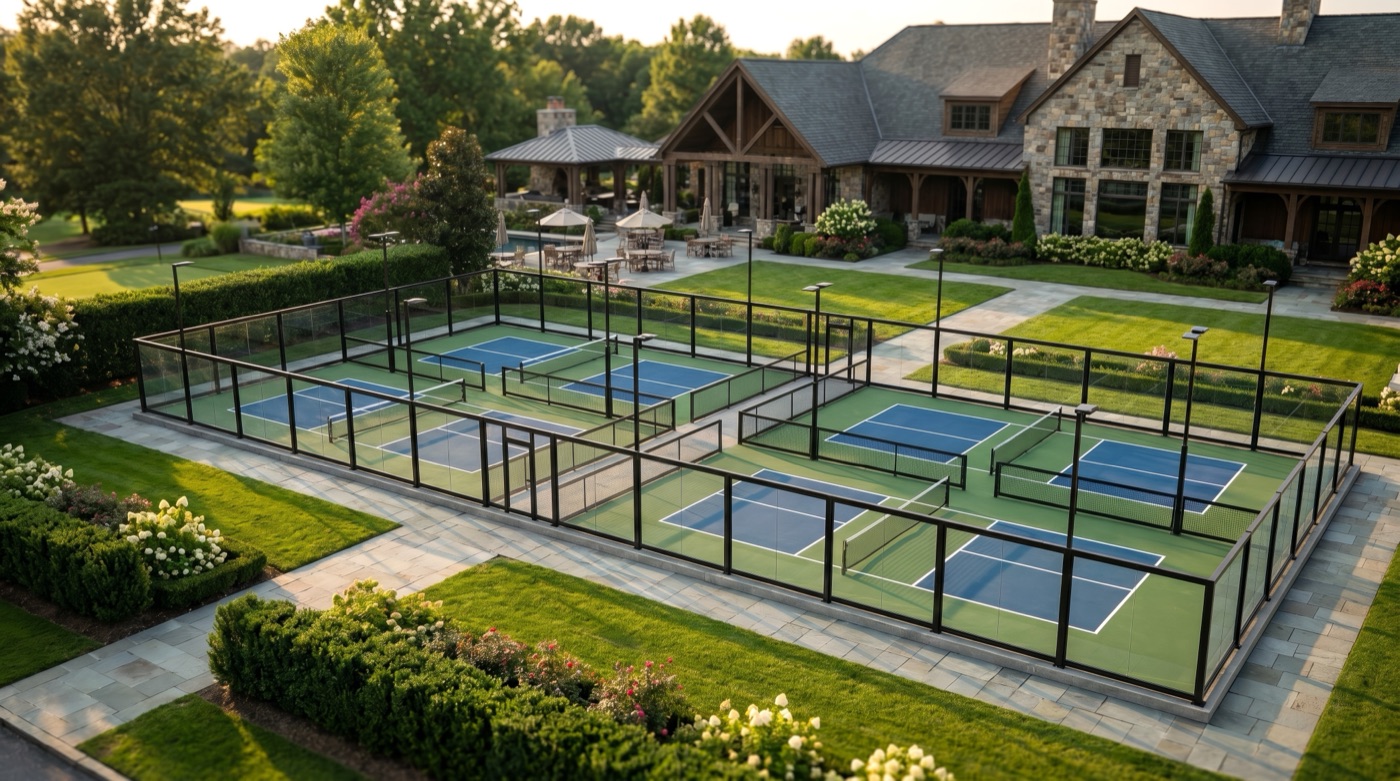
Most of the country club GMs and racquets directors who eventually engage PICKLETILE™ on a project describe some version of the same thing: they knew the conversation needed to happen earlier, but they were not sure what it would involve or whether the project was defined enough to make it useful.
The assumption is usually that a scoping conversation requires a finished scope, an approved budget, or at minimum a clear mandate from the board. None of that is true. The scoping conversation is most valuable before those things exist, because that is the window where the right project can be defined rather than reverse-engineered to fit a number that was set without full information.
Here is exactly what a 20-minute scoping conversation with PICKLETILE™ covers for a club racquet project.
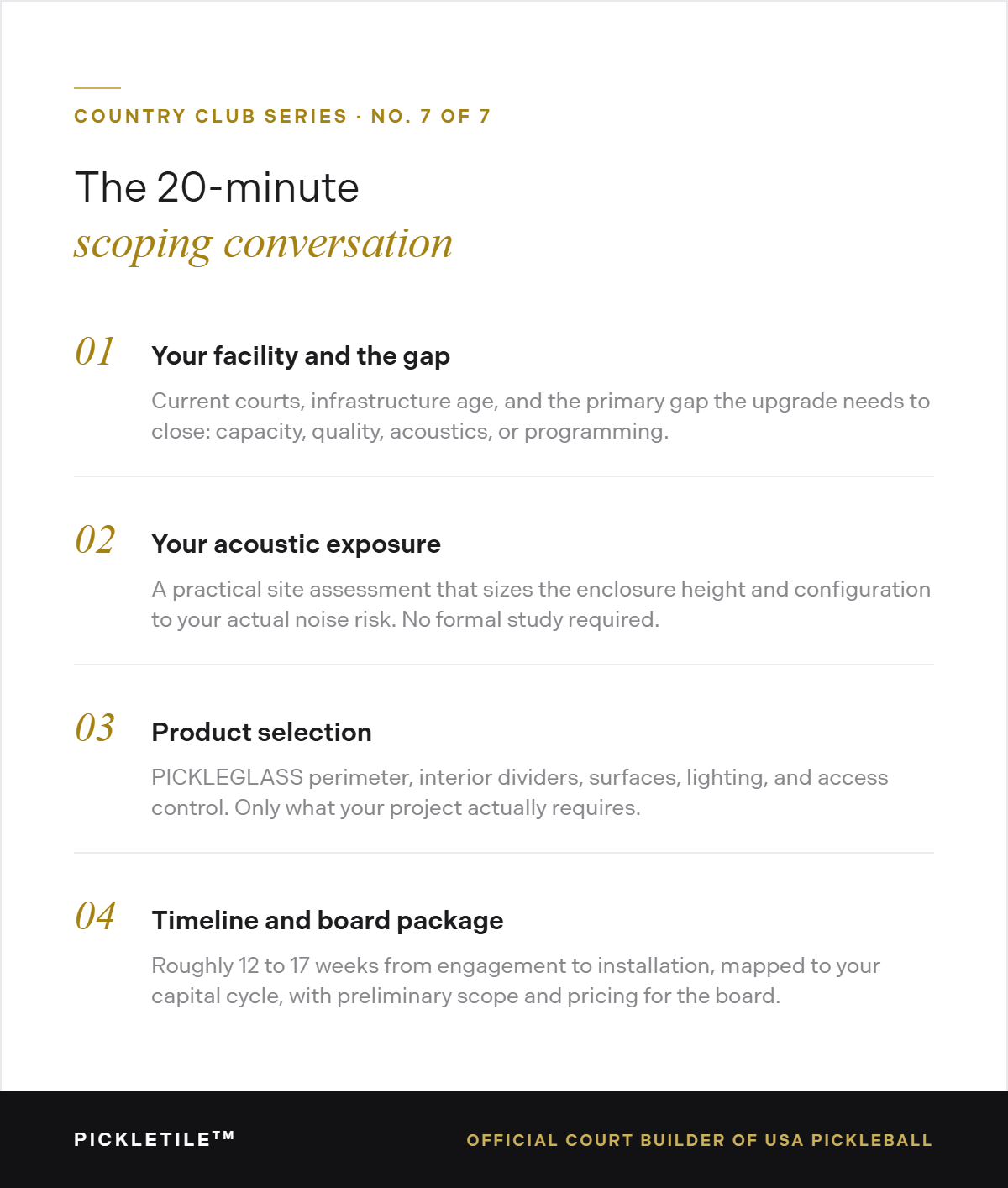
Your club’s current facility and the gap you are trying to close
The conversation begins with your current situation. What courts do you have, how old is the infrastructure, and what is the primary gap the upgrade is meant to address? That gap might be capacity, member experience quality, acoustic performance, programming capability, visual integration with the club’s environment, or some combination.
You do not need a formal needs assessment to answer these questions. A candid description of what your members are experiencing and what the racquets department is managing operationally provides the information needed to begin framing the right scope.
Your site’s acoustic exposure and what it means for the specification
If your club’s courts are within proximity of residences, a clubhouse terrace, a dining area, or any other noise-sensitive space, the scoping conversation will include an acoustic exposure assessment. This is not a formal study. It is a practical evaluation of whether your site creates noise risk that needs to be built into the specification.
For clubs in residential settings, this conversation is one of the most valuable 10 minutes in the entire project process. It determines whether the enclosure height and configuration is the right one for your acoustic requirement, or whether a standard specification is going to leave a gap that becomes a complaint problem after the facility opens.
All acoustic performance in a PICKLETILE™ court system comes from the full-height perimeter enclosure. That is the element that needs to be sized and specified correctly for your site. The scoping conversation is where that assessment happens.
Product selection and what your project actually requires
The conversation covers which products are appropriate for your project. Does your club need a full PICKLEGLASS™ perimeter enclosure for acoustic performance and architectural quality? Almost certainly, if the facility is in a location visible to members and adjacent to any noise-sensitive spaces. Does your multi-court layout require interior 4-foot glass dividers for ball containment between courts? Likely, if you are planning two or more courts in close proximity.
What the interior dividers do not do is contribute to acoustic performance. That point will come up explicitly in the scoping conversation because it is the single most common spec misunderstanding in club projects, and getting it right at the design phase prevents a noise problem from appearing post-completion.
Timeline alignment with your capital cycle and the board process
A PICKLETILE project from initial engagement to installation completion runs approximately 12 to 17 weeks under standard conditions. The conversation will map that timeline against your club’s capital approval process and construction calendar, and identify whether the project can be completed before your target season or whether a different sequence is needed.
For clubs that are building toward a board presentation, PICKLETILE™ can provide a preliminary scope, preliminary pricing, and the engineering documentation package needed to support a capital recommendation. Getting this material in front of the board with a credible infrastructure partner behind it changes the nature of the board conversation from a partner approval to a project approval.
What you leave with
At the end of 20 minutes, you will have a clear product recommendation for your club’s specific situation, a preliminary scope and configuration, a timeline that aligns with your capital cycle, and a quote that reflects your actual project requirements.
You will also have the information you need to bring a credible recommendation to the board without spending months in the planning phase. The conversation is free. The cost of another season with the wrong facility is not.
Request a quote now. We will get 20 minutes on the calendar and get your project moving.
You have enough to make this call productive right now. Let’s get the right project defined for your club.
