
Every GC who has built a court in a residential-adjacent site has lived the same story. The court goes in on time. The chain-link goes up. The windscreens go up. The owner asks about the noise. You tell them the windscreens will help. They don’t help, or at least not enough. Six months later someone on the HOA board is emailing the owner, the owner is emailing the property manager, and the property manager is emailing you asking if there’s something you can do.
By then the answer is expensive. You are back on a finished site adding acoustic treatments that should have been engineered into the build from the start, and the client is unhappy about a facility they thought was done.
This article is about the version of that story where none of it happens, and about a scope you can bring into a project once and never revisit.
The chain-link plus windscreen approach was never built for this
Chain-link fence combined with vinyl or mesh windscreens was the default for tennis courts for forty years. It worked for tennis because tennis is not primarily an acoustic problem. Ball speed is high but impact frequency is low, and the sound profile does not carry the way pickleball sound carries.
Pickleball is different. The paddle-on-ball impact produces a high-frequency signature that reads as sharp and repetitive to the human ear, and it travels. In a typical residential-adjacent installation, unmitigated pickleball sound propagates at approximately 82 dBA at 25 feet from a single court, dropping only to 73 dBA at 100 feet. That is well within complaint range at any residential setback distance a developer, HOA, or country club is likely to work with.
Chain-link fabric has a Sound Transmission Class rating of zero. It is an open lattice designed to contain a ball, not to attenuate sound. Windscreens add negligible acoustic value, are rated for wind loads far below what most sites actually experience, and are the first thing on a facility to look tired. Within a season or two on any coastal, high-plains, or high-wind site, you have partially detached windscreens flapping against the fence and clients asking who is responsible.
None of this is news to a GC who has been on a court job in the last five years. The problem is that no one has offered a scope that does the sound work correctly and looks like architecture instead of infrastructure.
What PICKLETILE™ delivers into a court scope
PICKLETILE is a racquet sports infrastructure and engineering partner. On a GC-led project, PICKLETILE takes the court and enclosure scope end to end, with PE-stamped engineering, shop drawings, and a single point of accountability for surfacing, structure, glass, lighting integration, and access.
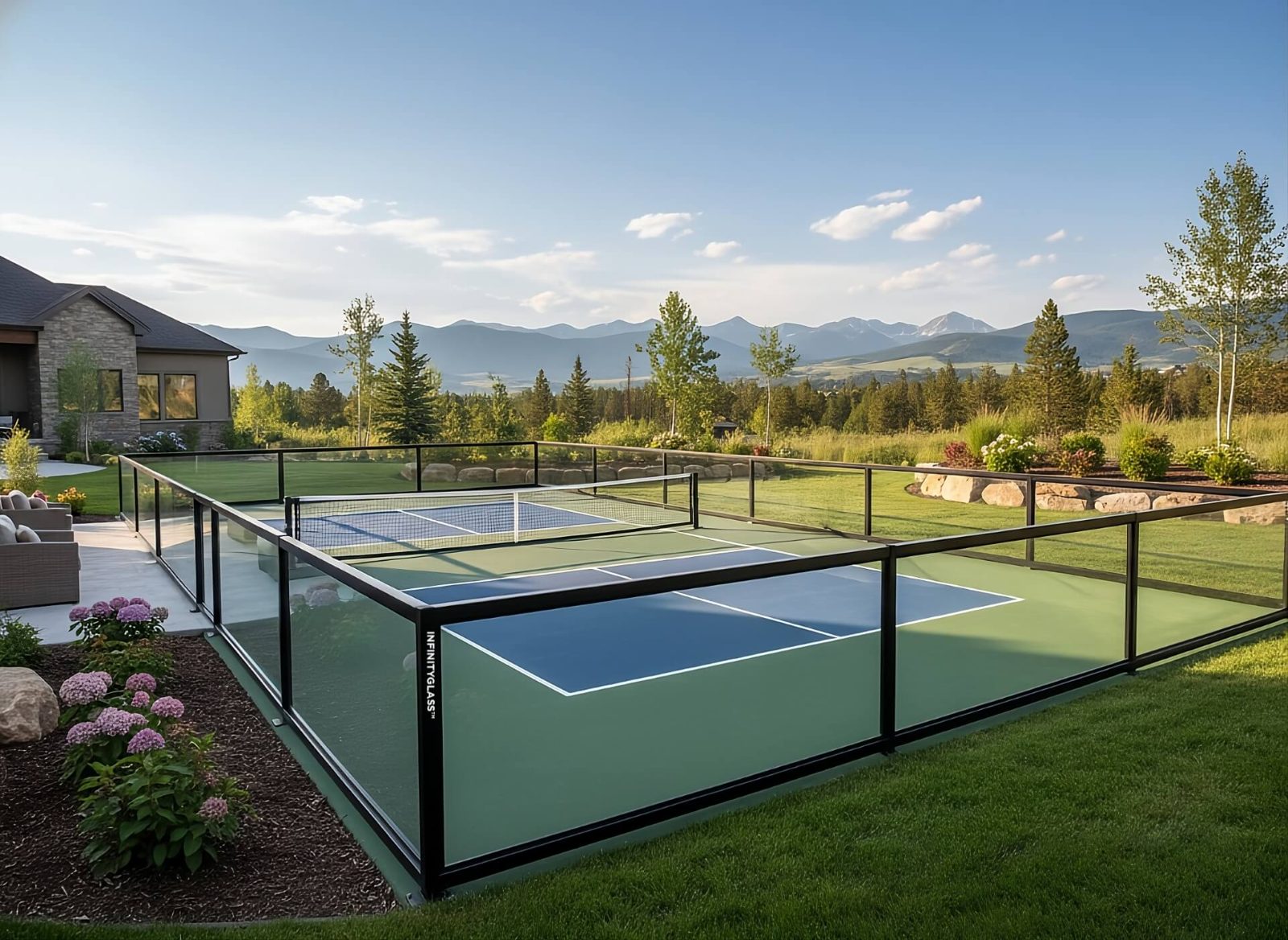
The flagship enclosure system, PICKLEGLASS™, is a full-height structural glass system engineered around the acoustic problem chain-link creates. Ten-foot panel height is the default specification. Thirteen-foot is available for noise-sensitive sites where the modeling calls for it. The frame is HSS ASTM A500 Grade B steel with matte black powder coat certified to AAMA 2604/2605 architectural finish standards. Wind loading is engineered to 125 to 200 MPH depending on exposure category.
The acoustic performance is measurable and independently verified. PICKLEGLASS carries a Sound Transmission Class rating of 36 and delivers 10 to 16 dBA of noise attenuation depending on barrier height and receiver distance. That is up to fifty percent perceived sound reduction across the property line. The performance data was modeled by Trinity Consultants and Cerami Longman Lindsey using CadnaA software against ISO 9613-2 acoustic propagation standards, with source noise measured at 91 dBA at 15 feet from live pickleball play.
PICKLEGLASS is the Official Acoustic Solution of USA Pickleball. PICKLETILE is the Official Court Builder of USA Pickleball. On a GC’s paperwork, both of those credentials do meaningful work for the owner conversation.
What changes on your job site
The reason to look at this scope is not the acoustic data alone. It is what the delivery model does to the coordination burden on the job.
One sub, not five. A conventional court build is five contracts, five schedules, five insurance certificates, five warranty holders, and five phone numbers to call when something at the interface fails. Foundation, surfacing, fence, windscreen, lighting. PICKLETILE delivers the full scope as one integrated system with one PM, one submittal package, one warranty, and one number to call. The coordination overhead compresses dramatically. On a project running two dozen scopes, cutting five into one is meaningful in itself.
Documentation that clears permitting. PICKLEGLASS ships with PE-stamped structural drawings, wind load calculations against ASCE 7-16 exposure and risk categories, and full compliance documentation against IBC 2024, AISC 360-22, and AWS D1.1. Every component references the ASTM standards a plan reviewer wants to see. On sites where the enclosure sits in a permit corridor, this scope moves. It does not sit in reviewer purgatory for six weeks while someone tracks down glazing certifications.
No punch list rework. The enclosure does not need windscreens. It does not need retrofitted acoustic panels. There is no follow-on scope. Once the system is up and the surfacing is signed off, the enclosure is finished. The facility looks like it should have from day one, and it will still look like that in year ten.
Predictable delivery. A typical PICKLETILE court build runs 9 to 12 weeks from mobilization once foundation is set. PICKLEGLASS fabrication runs 90 to 110 days from order to site. On a job you are sequencing three months out, both of those numbers are in-hand and locked, not aspirational.
What the owner conversation sounds like when you have this in your bag
An owner-side conversation about court noise is uncomfortable when the answer is chain-link and windscreens, because the owner has usually already read about pickleball noise litigation and is worried about it. The GC ends up defending a scope they did not choose against a concern they did not create.
That conversation looks different with PICKLEGLASS in the specification. The answer to “what about the noise” is a document. It is the acoustic study with the modeling from Cerami Longman Lindsey. It is a barrier attenuation table with numbers the owner can hand to their board or their capital partner or their HOA counsel and have the concern resolved before it becomes an item. The GC becomes the person who solved a problem the owner didn’t know had a solution, on a facility that reads as architecture rather than as a fenced-in utility.
That is a different position to be in on a job.
Where PICKLETILE fits on the type of project you already run
The PICKLEGLASS scope shows up cleanly on:
- Country club and racquet facility projects. New builds and conversions. Boards approve the acoustic story easily because the acoustic story is the primary obstacle. Getting a court project past a board is the reason PICKLEGLASS exists.
- Multifamily and mixed-use developments. Any residential building with amenity courts on the site plan. The noise story is the difference between amenity marketing and complaint management post-CO.
- Master-planned communities and HOA sites. Especially anywhere the site plan puts courts within 200 feet of a residence. This is where the modeling matters. The 10-foot system delivers 12 to 13 dBA of attenuation at 100 feet, which is often the difference between a facility that gets used and a facility that gets restricted hours after resident complaints.
- Hospitality projects. Resorts, boutique hotels, and destination properties where courts are part of guest experience. A commodity enclosure does not read as a premium amenity. Glass does.
- Municipal and parks projects. Where community sound complaints are foreseeable and lifecycle cost is under scrutiny.
If you are running a project that fits any of those descriptions, the conversation is worth having before your enclosure scope is finalized.
What the referral relationship looks like
PICKLETILE runs a formal referral program for GCs who bring court and enclosure scope. On any project where PICKLETILE is engaged through your referral and delivers the scope, we pay a referral fee on the enclosure and court system revenue.
The mechanics are simple. You introduce us to the project. We handle the scoping, the engineering, and the delivery under our own contract or as a specialty sub on yours, whichever fits the project structure best. The referral fee is paid at project completion.
The value calculation is straightforward. On a typical two-court PICKLEGLASS installation, the fee represents a five-figure payment for what amounts to an email introduction and a handoff. On a multi-court hospitality or country club project, it is a materially larger number. The scope is not something you would have built or subbed out at margin anyway, and it removes a coordination headache from the project rather than adding one.
The next step
If you have a project on the boards right now with a court scope in it, or if you have a project that has been sitting in preliminary design because the owner is nervous about the noise conversation, that is the project to run this by us on.
Send us the site, the proposed court count, and the setback conditions. We will come back with a preliminary acoustic modeling summary and a scope-level budget for the enclosure system. If it moves forward, the referral relationship is documented before the introduction to the owner.
PICKLETILE is the Official Court Builder of USA Pickleball. PICKLEGLASS is the Official Acoustic Solution of USA Pickleball.
