
If your pickleball court sits anywhere near homes, an office, or a shared property line, the enclosure you choose will decide whether the court can run the hours you planned for. The sharp “pop” of a pickleball paddle peaks around 70 decibels at the source and carries a high-frequency spike near 1.2 kHz that the human ear finds especially intrusive. A standard chain-link fence does almost nothing to stop it. An enclosure designed for sound can.
This guide compares the acoustic enclosure options available for pickleball courts, what each one actually does to noise, and where each fits, so you can plan for sound before it becomes a complaint rather than after.
The options at a glance
| Option | How it reduces noise | Noise performance | Sightline and design | Best fit |
|---|---|---|---|---|
| Windscreen / mesh | Minimal; blocks wind and view, not sound | Low | Opaque, utilitarian | Privacy and wind only, not noise |
| Chain-link fence | Containment only | Negligible | Open, industrial | Low-sensitivity sites with no neighbors |
| Acoustic fencing (composite or absorptive panels) | Adds mass and absorption to block and dampen sound | Moderate | Solid, panel appearance | Property-line screening on a budget |
| Sound barrier wall (mass-loaded or concrete) | High mass blocks transmission, breaks line of sight | Moderate to high | Solid, heavy visual footprint | Aggressive noise control where aesthetics are secondary |
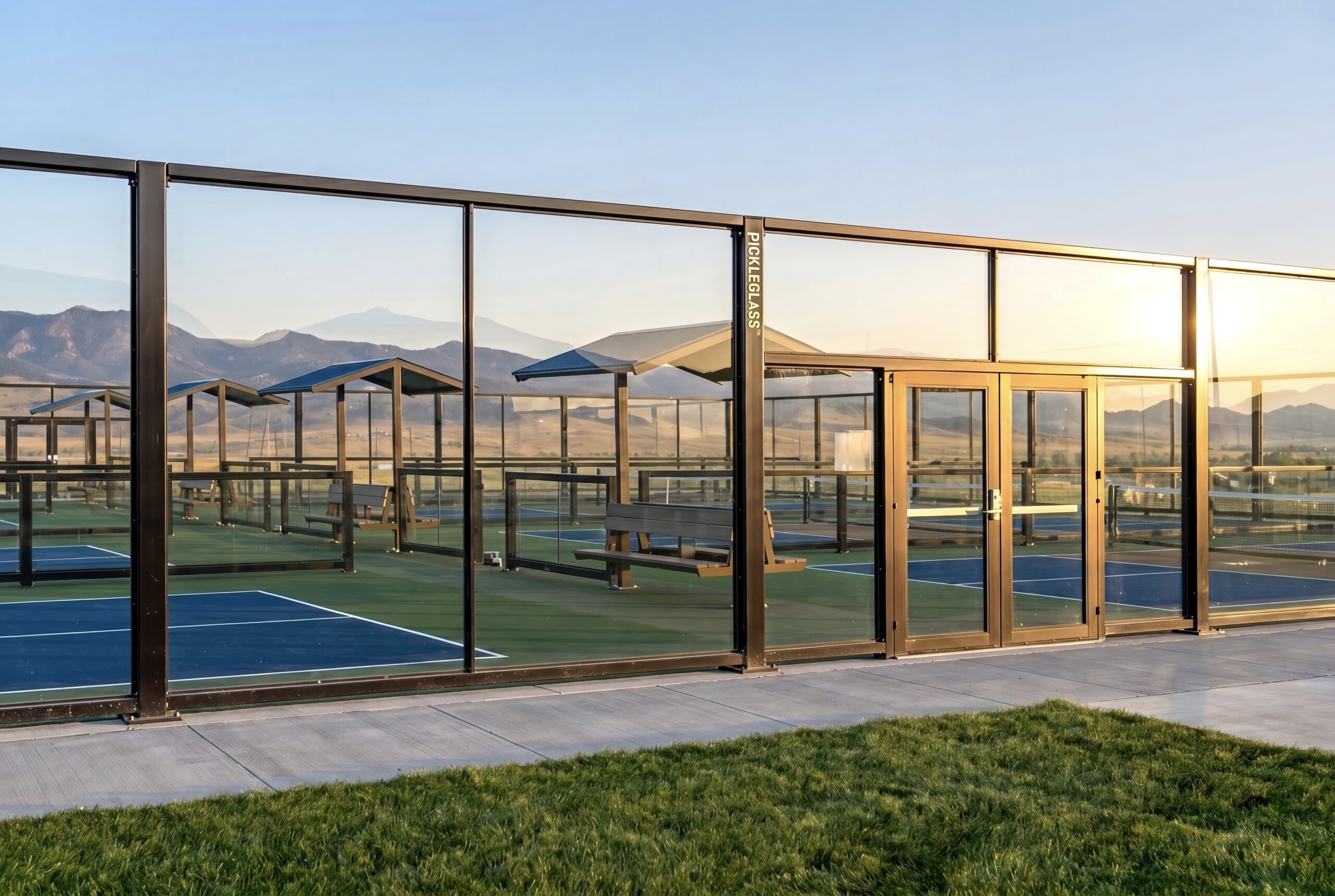
| Structural glass acoustic enclosure | Engineered glass system, rated assembly, full enclosure | High | Transparent, architectural | Premium, residential, and mixed-use sites where sound and appearance both matter |
What actually controls pickleball noise
Three principles separate an enclosure that works from one that only looks like it should.
Mass blocks sound; gaps defeat it. Sound transmission loss rises with the mass and continuity of a barrier. A heavy, sealed assembly stops far more sound than a light or perforated one, and a single gap at the base or between panels leaks noise that undermines the whole structure. This is why mesh and chain-link, which are almost entirely open area, provide effectively no acoustic benefit.
The barrier has to break the line of sight. A noise barrier only works when it interrupts the straight path between the sound source and the listener. For pickleball, the source is paddle-to-ball contact at roughly waist to chest height, and the receiver may be a neighbor on an elevated deck or a second floor. A short fence that the sound travels straight over does little. Effective barriers generally need real height and have to be positioned close to the court, because a barrier near the source shades a larger acoustic shadow than one set far away.
Frequency matters. The pickleball pop concentrates energy in a high-frequency band that carries and annoys out of proportion to its raw decibel level. Systems that combine blocking mass with some absorptive treatment manage that band better than a hard reflective wall alone, which can bounce sound toward other neighbors.
These are the reasons acoustic performance is described with engineering measures rather than marketing claims. Sound transmission class, or STC, rates how well an assembly blocks airborne sound; the higher the number, the more it stops. PICKLEGLASS™ structural glass enclosure panels have been lab-tested at STC 36, a level a chain-link fence cannot approach, while keeping the court visually open rather than walling it off.
Matching the enclosure to the site
The right option depends less on the court than on what surrounds it.
Open or rural sites with no close neighbors rarely need an acoustic enclosure at all. Containment fencing is enough, and spending on sound control there is wasted budget.
Property-line screening on a budget is where acoustic fencing earns its place. Composite or absorptive panels add enough mass to take the edge off transmission to an adjacent yard, at a cost well below a full engineered enclosure.
Aggressive noise control where appearance is secondary, such as a court backing onto a parking structure or industrial edge, is the case for a solid sound barrier wall. It blocks the most sound per dollar, at the cost of a heavy visual presence and a walled-in feel for players.
Residential, club, and mixed-use sites where both sound and appearance matter are where a structural glass acoustic enclosure fits. It delivers rated acoustic performance and breaks the line of sight while keeping the court transparent and architecturally intentional, rather than ringed by an opaque wall. For how this system addresses the noise problem specifically, see PICKLEGLASS and pickleball court sound suppression.
From noise control to facility engineering
It is tempting to treat the enclosure as the last item on a court budget, a fence to add once the surface is down. On any noise-sensitive site, that ordering is exactly backward. The enclosure is one of the few elements that determines whether the facility can legally and neighborly operate the hours it was built for, and it is far cheaper to design in than to retrofit after the first complaint.
That is the shift from buying a fence to engineering an enclosure. A fence contains players. An enclosure is acoustic infrastructure, planned around the specific neighbors, sightlines, and frequencies of the site it serves, and integrated into the architecture rather than bolted on at the end. The communities that plan acoustics as a design input, not an afterthought, are the ones whose courts are still running full schedules years later.
To understand the underlying problem these systems solve, see understanding pickleball noise complaints and our practical guide to how to reduce pickleball noise. For general containment and screening choices, see pickleball court fencing options.
Frequently asked questions
What is the best acoustic enclosure for a pickleball court?
It depends on the site. For premium, residential, and mixed-use settings where both noise and appearance matter, a rated structural glass enclosure performs best while keeping the court open. For budget property-line screening, acoustic fencing panels are a reasonable step up from chain-link. Open sites with no close neighbors usually need only containment fencing.
Does a regular fence reduce pickleball noise?
No. Chain-link and mesh windscreen are mostly open area and provide effectively no sound transmission loss. Reducing noise requires a continuous, sealed barrier with real mass that breaks the line of sight between the paddle and the listener.
How loud is pickleball noise?
Paddle-to-ball impact peaks around 70 decibels at the source, with a high-frequency component near 1.2 kHz that travels and annoys out of proportion to its decibel level. That frequency profile is why pickleball draws complaints that other court sports often do not.
What is STC and why does it matter for pickleball enclosures?
STC, or sound transmission class, rates how well a building assembly blocks airborne sound; higher is better. It lets you compare enclosure systems on measured performance rather than marketing claims. PICKLEGLASS™ panels are lab-tested at STC 36, well beyond what open fencing can offer.
Is it cheaper to plan acoustics upfront or add an enclosure later?
Almost always cheaper upfront. Retrofitting noise control after complaints often means restricted playing hours, emergency barriers, or relocating courts, all of which cost more than designing the enclosure into the project from the start.
