
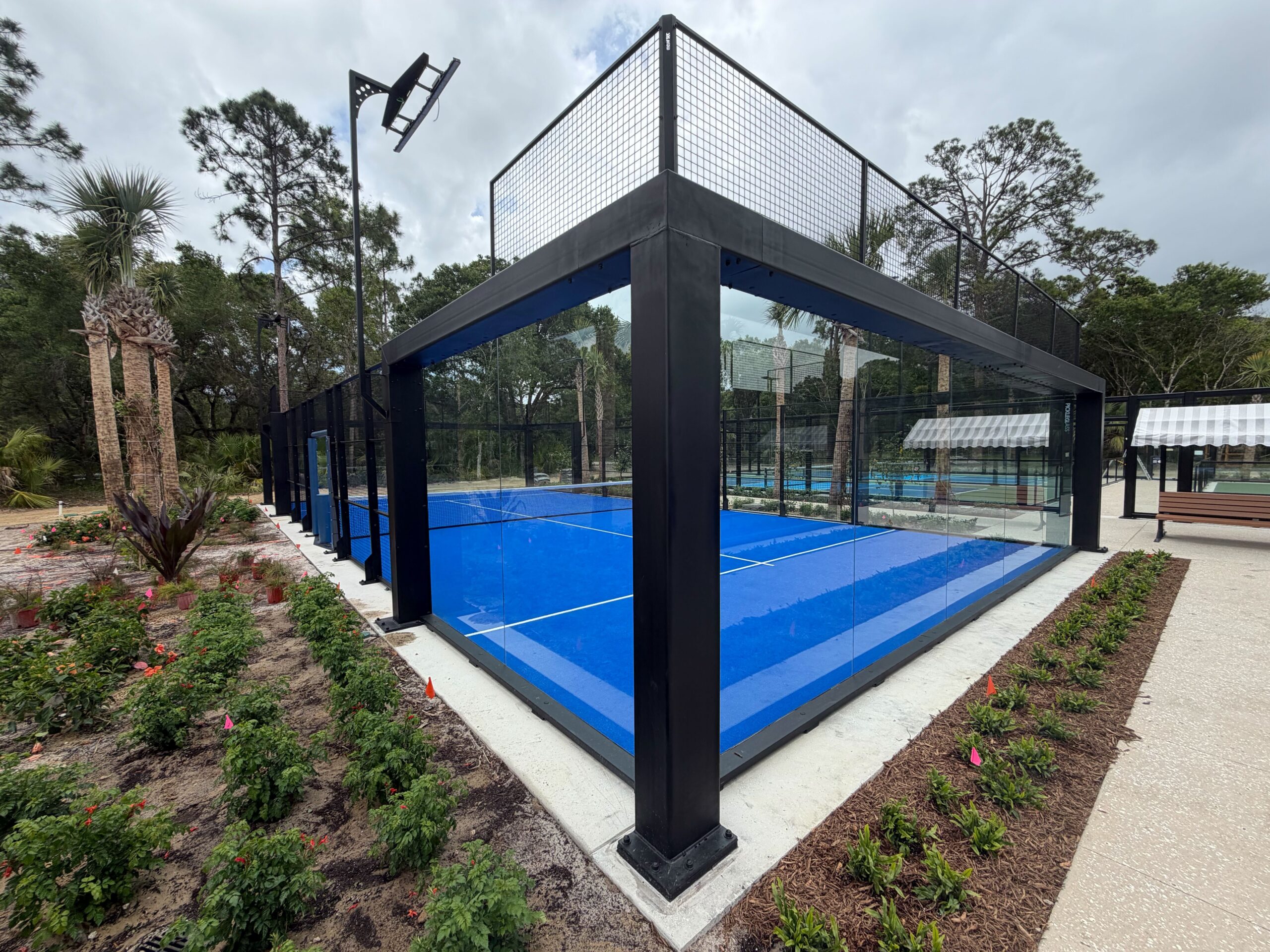
What lines does a padel court need?
A regulation padel court carries a small, fixed set of lines: two service lines, a center service line that splits each service box, and the side and back boundary lines formed by the court perimeter. Compared with tennis, the padel layout is simpler on paper but less forgiving in practice, because the enclosure walls sit directly on the boundary and every line has to register cleanly against a turf surface rather than a hard coat.
This page covers the regulation line layout, the materials used to mark a turf padel court, the painting and pre-lined-turf options, and how line work coordinates with the base, the surface, and the glass enclosure. If you are planning the court itself, start at padel court construction and padel court dimensions, then use this page for the markings layer.
Regulation padel line dimensions
Padel is played on a court measuring 20 meters by 10 meters (about 66 feet by 33 feet). The lines that matter for play are the service lines and the center service line:
Service lines run parallel to the net, set 6.95 meters (about 22.8 feet) from the net on each side.
Center service line runs perpendicular to the net, dividing each service zone into two equal boxes, and extends from the net to the service line.
Line width is 5 centimeters (about 2 inches) for all playing lines.
Boundary lines are defined by the walls and fencing at the court perimeter, so the side and back limits are the enclosure itself rather than a painted line.
The net divides the court across the middle at 20 meters length, standing 0.88 meters high at the center and 0.92 meters at the posts. Because the enclosure defines the outer boundary, line painting on a padel court is concentrated in the interior service area, which is a meaningful difference from tennis and pickleball line work.
Line materials on a synthetic turf surface
Most padel courts use a synthetic turf playing surface with a sand infill, and that changes how lines are created. There are two common approaches:
Pre-lined turf. The turf is manufactured with white line rows tufted directly into the carpet. The installer inlays the white turf strips into the field turf during installation, cutting and seaming them into position. This is the most durable option because the line is part of the carpet, not a coating on top of it, so it does not wear off with play or brushing.
Painted or inlaid lines on existing turf. On a court that is being re-marked or corrected, lines can be cut in from white turf strips or, less commonly, painted with a turf-compatible acrylic. Paint on turf wears faster than inlaid line strips and needs the infill brushed back before application, so inlaid strips are the more common long-term choice.
If your court uses a cushioned acrylic or a hard surface rather than turf, line work follows the same acrylic striping process used on tennis and pickleball courts, and the padel court surfaces page covers that surface decision in full.
How padel lines are installed
On a turf padel court, line installation is part of the surfacing sequence rather than a separate painting job at the end:
1. Confirm the layout against the enclosure. The service lines are measured from the net line, and the whole interior grid has to sit square inside the 20 by 10 meter enclosed footprint. Errors here are difficult to correct once turf is seamed, so the layout is snapped and checked before any cutting. 2. Roll and seam the field turf. The main turf is installed and seamed across the court. 3. Inlay the white line strips. White turf strips are cut to the 5 centimeter line width, set into channels cut in the field turf, and seamed so the top of the line sits flush with the playing surface. 4. Spread and brush the sand infill. Silica sand is spread across the court and brushed into the fibers, including over the line rows, so the lines and the field wear evenly.
Because the lines are seamed into the carpet, a turf padel court does not need annual re-striping the way an acrylic court does. Line maintenance becomes a matter of keeping the infill balanced and the seams sound, which the padel court maintenance page covers.
Blended and multi-sport line questions
Padel courts are almost always dedicated single-sport courts because the enclosure geometry is specific to padel, so blended multi-sport striping is far less common than it is with tennis and pickleball. If you are weighing padel against other racquet sports for a multi-court facility, the padel vs pickleball comparison and the facility planning guide are better starting points than trying to co-locate padel lines with another sport on one slab.
How line work fits the whole court
Lines are the last visible layer, but they depend on everything underneath. The service line positions only stay true if the base is flat and the enclosure is set square, and the lines only stay bright if the turf and infill are maintained. Treat the markings as one element of an integrated build rather than a finishing afterthought.
If you are scoping a padel court or a multi-court padel facility for a club, resort, or community, you can request an estimate at https://pickletile.com/instant-estimate/.
Frequently asked questions
How many lines are on a padel court?
A padel court has service lines on each side of the net and a center service line that divides each service area into two boxes. The side and back boundaries are formed by the glass and mesh enclosure rather than by painted lines, so the painted or inlaid line work is concentrated in the interior service zone.
What are the dimensions of padel court lines?
Playing lines are 5 centimeters wide (about 2 inches). The service lines sit 6.95 meters (about 22.8 feet) from the net on each side, and the center service line runs from the net to the service line, splitting each service zone into two equal boxes on a court that measures 20 by 10 meters.
Are padel court lines painted or built into the turf?
On synthetic turf courts, which are the most common, the lines are usually white turf strips inlaid and seamed into the field turf rather than painted. Inlaid line strips last far longer than paint because the line is part of the carpet and does not wear off with play or brushing.
Do padel court lines need to be repainted?
A turf court with inlaid line strips does not need routine re-striping. Line upkeep is mostly a matter of keeping the sand infill balanced and the seams intact. Acrylic-surfaced padel courts follow the same re-striping cycle as tennis and pickleball hard courts.
What color are padel court lines?
Padel court lines are white, providing contrast against the blue or green turf that most courts use. White is the standard for visibility and for consistency with competition requirements.
