
The amenity investment brief your partner is waiting for.
AUSTIN, Texas – Apr. 26, 2026 – At many development firms, the principal or managing partner who’s been evaluating the court scope isn’t the only person who needs to approve the amenity budget. There’s often an equity partner, an asset manager, a co-investor, or an investment committee that reviews capital allocations above a certain threshold.
That audience hasn’t been in the court conversations. They haven’t seen the estimate, toured comparable facilities, or heard the noise data. They’re evaluating a capital allocation request based on a brief presentation or a forwarded document, and they’re making the decision quickly because they have dozens of other line items to review.
What that audience needs is fundamentally different from what the principal needs. The principal needs to understand the product. The approver needs to understand the investment case.
Getting the approval efficiently typically requires two things: a concise investment summary prepared by the ownership group, and construction-specific validation from the construction team that confirms the scope fits the project. Here’s how both contributions come together.
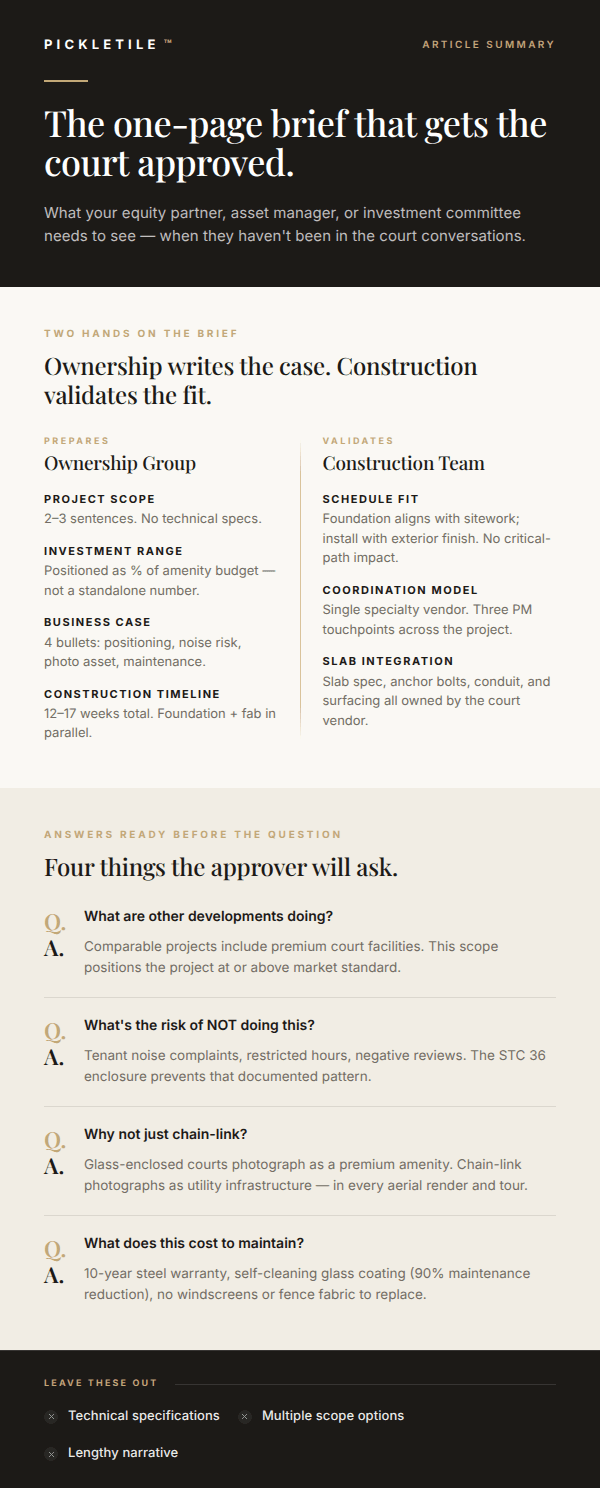
The one-page investment summary (ownership group prepares this)
The principal or managing partner prepares and presents this document. It should fit on one page, take no more than 2 minutes to scan, and answer every question the approver will ask without requiring a follow-up meeting.
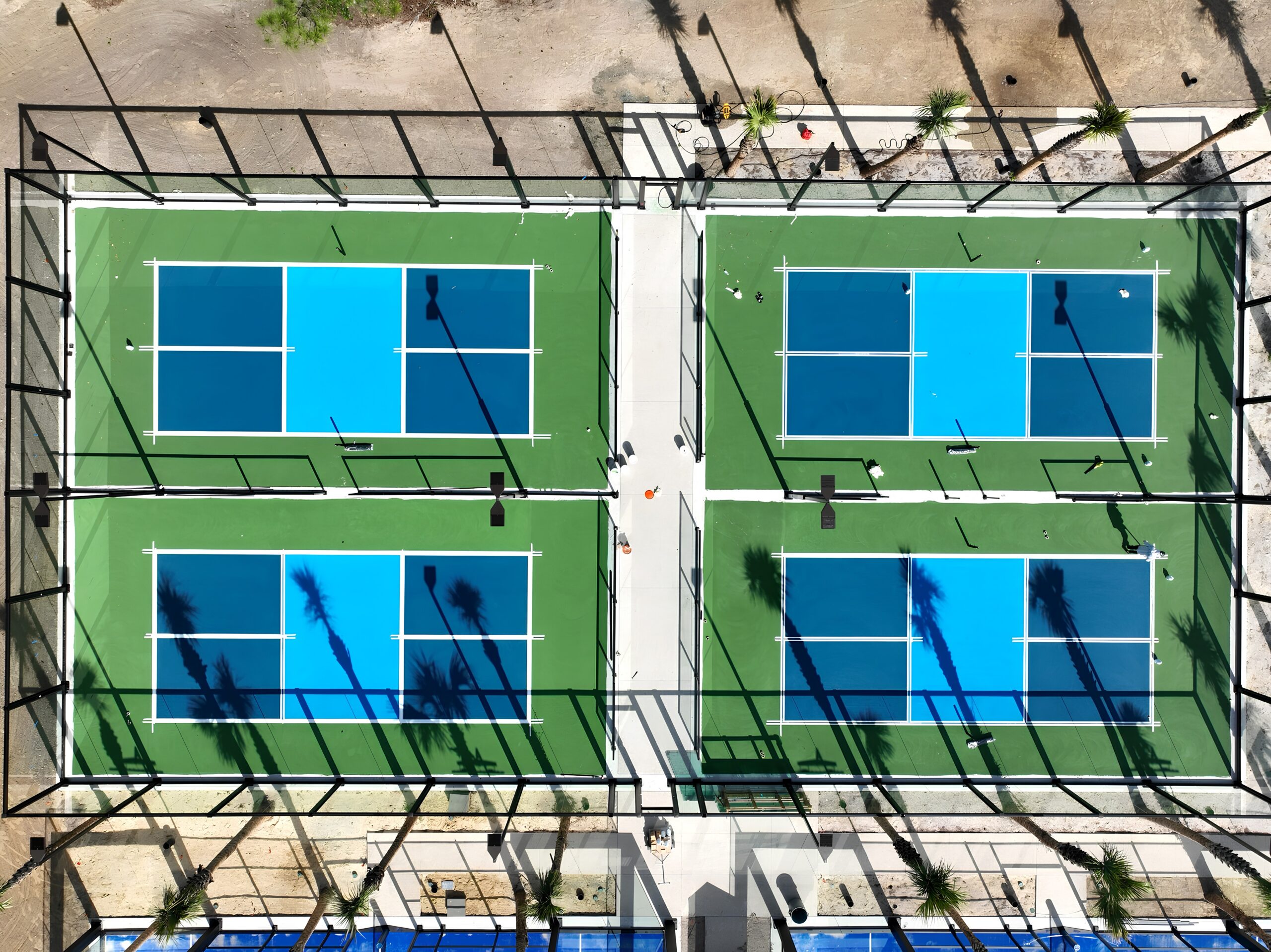
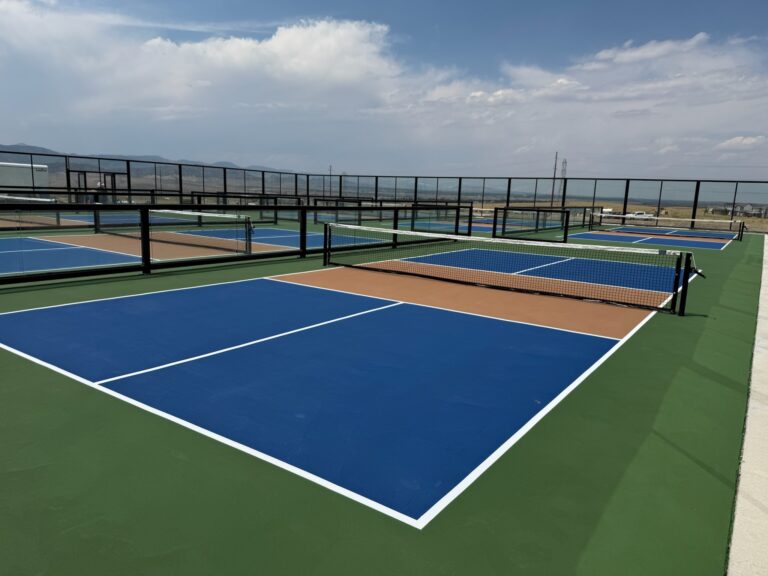
Project scope (2 to 3 sentences). What’s being built, how many courts, what type of facility. No technical specifications. No product names the approver hasn’t heard of. Just: “The development includes [X] dedicated pickleball courts enclosed in a structural glass system with integrated LED lighting, professional sport surfacing, and acoustic engineering. The facility is designed and built by the Official Court Builder of USA Pickleball.”
Investment range. The capital allocation required, presented as a range (not a precise number, which invites negotiation on individual line items). Position the number in context: “This represents approximately [X]% of the total amenity budget and is comparable to [X]% of the pool facility investment.”
Why context matters: the approver evaluates the court investment relative to the total amenity budget, not in isolation. A number presented without context gets scrutinized as a standalone expense. The same number presented as a percentage of the amenity budget and compared to the pool or fitness center investment gets evaluated as a proportionate allocation within an approved category.
Why this scope (3 to 4 bullets). The business case in the language the approver speaks:
Competitive positioning. Comparable developments in the market are including premium court facilities. This scope positions the project at or above market standard. If the approver asks “what are other developments doing?”, the answer is ready.
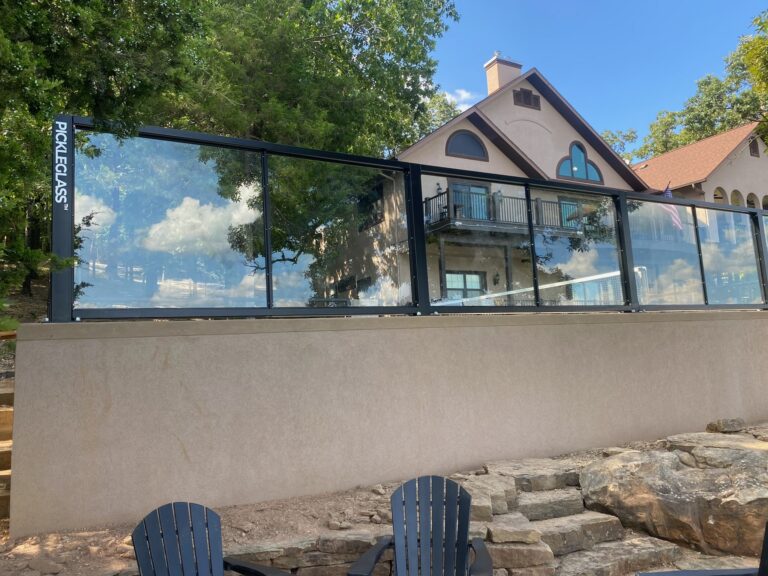
Acoustic risk mitigation. Courts adjacent to residential units without acoustic engineering create a documented pattern of tenant noise complaints, restricted playing hours, and negative reviews. The glass enclosure (STC 36 rating) prevents this. If the approver asks “what’s the risk of not doing this?”, the answer is ready.
Marketing asset quality. The court facility appears in every aerial rendering, drone shot, and site photo. Glass-enclosed courts photograph as a premium amenity. Chain-link photographs as utility infrastructure. If the approver asks “why not just do chain-link?”, the answer is ready.
Maintenance profile. 10-year warranty on steel corrosion, self-cleaning glass coating (90% maintenance reduction), no windscreens or chain-link fabric to replace. Long-term operating cost is significantly lower than conventional construction. If the approver asks “what does this cost to maintain?”, the answer is ready.
Construction timeline. Approximately 12 to 17 weeks total. Court foundation construction (~45 days) and enclosure fabrication (~90 days) run in parallel. 3 to 7 days on-site for enclosure installation. No impact on the core building construction schedule.
What’s decided now vs. later. Scope confirmation locks: project direction, court count, and investment range. Design details (layout, colors, door placement, lighting configuration) are finalized during the design phase with the development team’s input and approval. This is important for the approver to understand because it means they’re approving a direction and a budget range, not a finished design. The precision comes later, in a process the development team controls.
The construction team’s contribution to the approval package
The principal prepares the investment case. But approvers sometimes ask construction-related questions that the principal can’t answer on the spot. Having the construction team’s input ready, either as talking points the principal can reference or as a brief addendum to the one-pager, strengthens the approval package and prevents the “let me get back to you” delay that pushes the decision to the next meeting.
What the PM or director of construction should be prepared to provide:
Schedule confirmation. “The court scope fits our master schedule. The 45-day foundation phase aligns with our sitework window. The enclosure fabrication runs off-site in parallel with our construction. The installation (3 to 7 days) sequences with our exterior finishing phase. The court scope does not affect the critical path of the core building.”
This is the construction team’s validation that the scope is feasible within the project plan. If the approver asks “does this affect our construction schedule?”, the principal should be able to answer “no, our PM has confirmed it fits within the existing timeline.” That answer carries more weight when it comes from the construction team’s assessment, not from the court vendor’s marketing.
Coordination model confirmation. “This is a single-vendor scope. One partner handles the entire court facility: foundation, surfacing, enclosure, lighting, and installation. My team’s involvement is three touchpoints across the project: schedule coordination, design review, and punchout. The coordination burden is lower than most sub-scopes on this project.”
This addresses the approver’s unspoken concern: “Is this going to create problems during construction?” The PM’s confirmation that the scope is manageable and self-contained removes a risk factor the approver would otherwise have to assume.
Slab integration confirmation. “The court foundation integrates with our sitework scope. When the court vendor handles the full scope [the preferred model], there’s no additional coordination for my team beyond providing site access. The slab specification, anchor bolts, conduit routing, and surfacing are all managed by the court vendor as part of their integrated delivery.”
This is relevant because approvers who have experience with multifamily construction know that amenity scopes can create coordination headaches for the construction team. Confirming that this one doesn’t addresses that concern before it’s raised.
What NOT to include in the approval package:
Technical specifications (STC ratings, steel grades, glass thickness, wind load calculations). The approver doesn’t evaluate these. They evaluate the investment case. The technical specifications exist in the estimate and the engineering package for the teams that need them. The approver needs the business case, the budget context, the risk mitigation rationale, and the construction team’s confirmation that it fits the project.
Multiple scope options. Presenting the approver with three different scope alternatives (full glass, partial glass, chain-link) invites analysis paralysis and defers the decision. Present the recommended scope with the investment case. If the approver wants alternatives, they’ll ask.
Lengthy narrative. The approver is reviewing this alongside many other items. The entire summary should fit on one page with clear headers that can be scanned in under two minutes. The construction team’s input should be 3 to 4 sentences, not a separate document.
How the two groups prepare together:
The most efficient approach: the principal drafts the one-page investment summary covering scope, investment range, business case, and timeline. The PM or director of construction provides 3 to 4 sentences of construction validation (schedule fit, coordination model, slab integration). The principal incorporates those sentences into the one-pager or holds them as talking points for the approval conversation.
The principal’s job is to put the document in front of the approver and be available to answer questions. The construction team’s job is to make sure the principal has the construction-specific answers ready before the conversation, not after.
If the approver’s questions are about the investment case (competitive positioning, noise risk, maintenance profile, amenity budget proportionality), the one-pager addresses them.
If the approver’s questions are about construction impact (schedule, coordination, site disruption), the PM’s input addresses them.
If the approver’s questions are about the number (can we get this cheaper, what if we do chain-link, can we phase it), the previous emails in this series address them: the VE consequences, the bid comparison checklist, and the chain-link retrofit cost analysis all provide specific answers to those questions.
The format that gets approval:
One page. Clear headers. The investment case in 4 bullets. The number in context. The timeline. Construction validation in 3 to 4 sentences. No more than 2 minutes to read.
The principal presents the investment case. The PM has validated the construction fit. The document answers the approver’s likely questions before they’re asked. The approval is a capital allocation decision with supporting data, not an open-ended discussion about court construction.
If your team needs the one-page investment summary formatted for your specific project (with your scope, your investment range, your construction timeline, and your PM’s schedule validation), we can prepare it. The goal is to give you a document both groups have contributed to and that the principal can forward to the approver without needing to build a presentation around it. Let me know and I’ll put it together.
About PICKLETILE™
PICKLETILE™ is the leading design-build firm for premium pickleball court construction and the Official Court Builder of USA Pickleball.
Headquartered in Austin, Texas, PICKLETILE™ simplifies the complex construction process by offering turnkey solutions for residential, commercial, and club-level projects. The company is also the creator of PICKLEGLASS™, a patented soundproof glass wall system engineered to reduce noise by 50% while offering panoramic views and wind protection. For more information, visit www.pickletile.com.
