
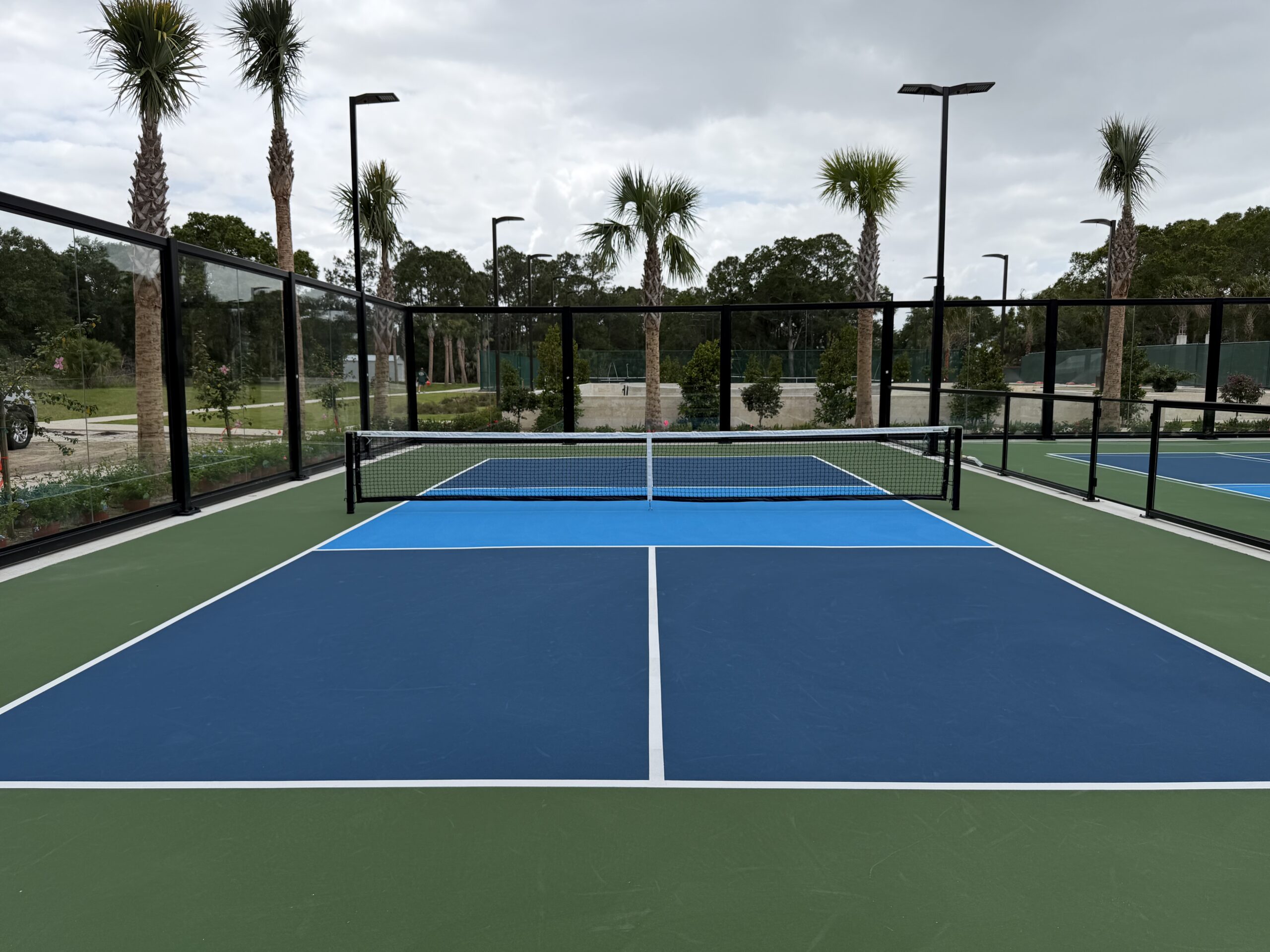
The court facility is actually one of the most predictable sub-scopes on a typical development. Here’s why.
AUSTIN, Texas – Apr. 10, 2026 – Change orders are the tax that PMs pay for uncertainty. The less defined a scope is at the time of commitment, the more likely it changes during execution. And every change costs more than it would have if it had been included in the original scope.
Court facilities, when properly scoped, have an unusually low change order profile compared to other sub-scopes on a multifamily development. The reasons are structural, not accidental, and they’re worth understanding if you’re evaluating how the court scope fits your project’s risk profile.
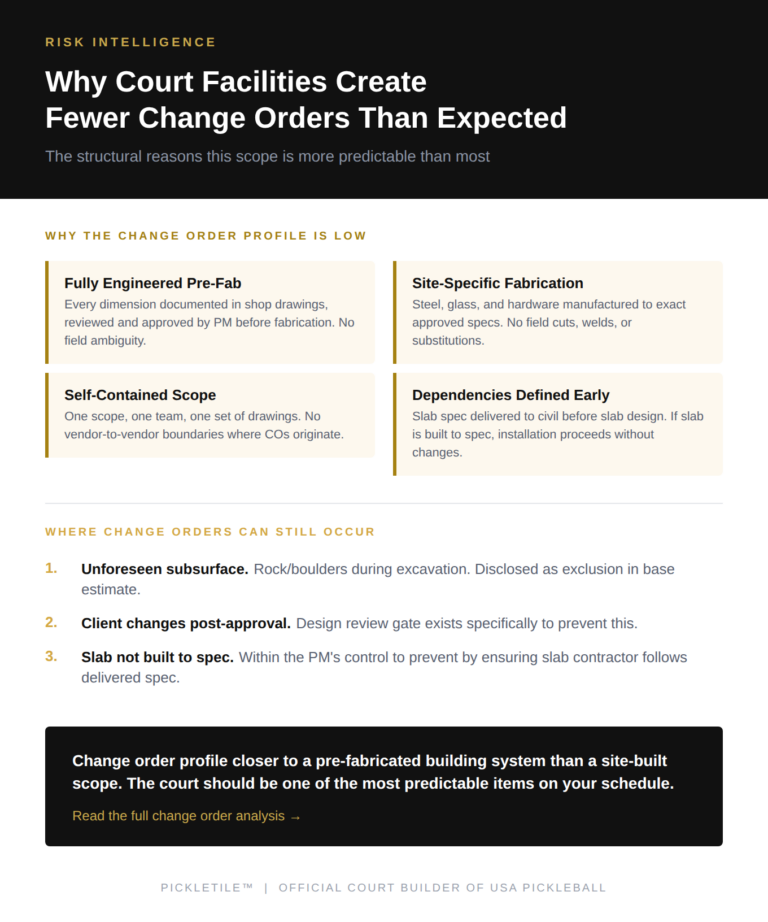
Why the change order risk is low:
The scope is fully engineered before fabrication. Unlike trades where the scope is partially defined at contract and refined in the field, the court facility goes through a complete engineering and design phase before anything is manufactured. Every post location, every panel dimension, every anchor bolt coordinate, every conduit path is documented in shop drawings that the PM reviews and approves. By the time materials arrive on site, there’s no ambiguity about what’s being installed or where it goes.
Materials are fabricated to site-specific dimensions. The steel frame, glass panels, and mounting hardware are manufactured to the exact specifications in the approved shop drawings. There are no field cuts, field welds, or material substitutions. What arrives on the truck is what was drawn, and what was drawn is what the PM approved. Field modifications are the exception, not the norm.
The scope is self-contained. The court facility is a single integrated scope with one set of drawings, one engineering team, one fabrication facility, and one installation crew. There are no scope boundaries between vendors where change orders typically originate. The fencing sub can’t blame the surfacing contractor because there is no separate fencing sub or surfacing contractor. One team is accountable for the entire result.
The site dependencies are defined in advance. The primary source of change order risk on court projects (across the industry, not just with integrated delivery) is slab-related: anchor bolts that weren’t set correctly, conduit that wasn’t routed, or a slab that doesn’t meet the structural specification. In the integrated model, the slab specification is produced during the design phase and delivered to the civil engineer before the slab is designed. If the slab is built to spec, the installation proceeds without field changes.
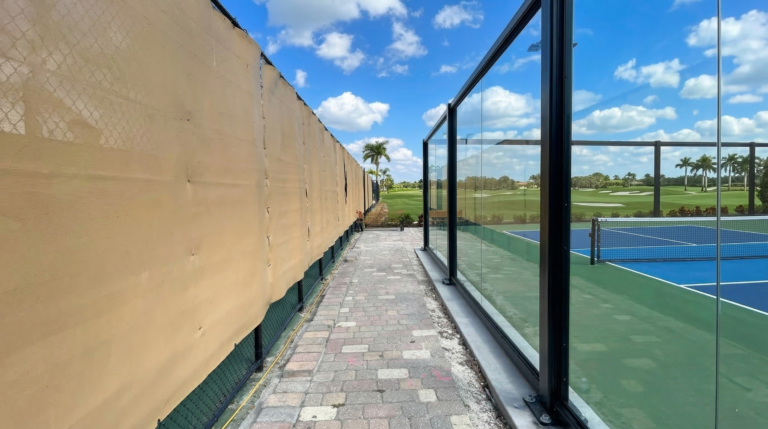
Where change orders can still occur:
Transparency matters, so here are the scenarios that can trigger scope changes:
Unforeseen subsurface conditions. If excavation for the court area encounters heavy rock, boulders, or unstable soil that wasn’t anticipated, the site preparation scope may need to be adjusted. This is disclosed as an exclusion in the standard scope (boulder and heavy rock removal is not included in the base estimate) and is addressed through a change order if encountered.
Client-requested scope changes after design approval. If the PM or Owner requests modifications to the approved shop drawings after the design phase is complete (different door location, different court count, different enclosure height), those changes require re-engineering and potentially re-fabrication, which creates a change order. The design review and approval process exists specifically to prevent this by giving the PM a clear approval gate before fabrication begins.
Slab not built to specification. If the slab in the court area doesn’t match the delivered specification (anchor bolts misplaced, conduit not routed, slab not at the correct tolerance), field modifications may be required during installation. This is the one change order scenario that’s within the PM’s control to prevent: ensuring the slab contractor builds to the specification that was provided.
What this means for the PM’s risk assessment:
The court facility scope, when properly executed, has a change order profile closer to a pre-fabricated building system than a site-built construction scope. The engineering is complete before fabrication. The materials are manufactured to approved drawings. The installation follows a defined sequence. And the scope boundaries that create coordination-related change orders in multi-vendor projects don’t exist.
For a PM evaluating the court scope against other sub-scopes on the project, the court facility should be one of the most predictable items on the schedule, not one of the riskiest.
If you’d like to walk through how the scoping and design process works, and how the documentation package reduces change order risk for your specific project, that’s what the scoping call covers. Reach out today to schedule a call.
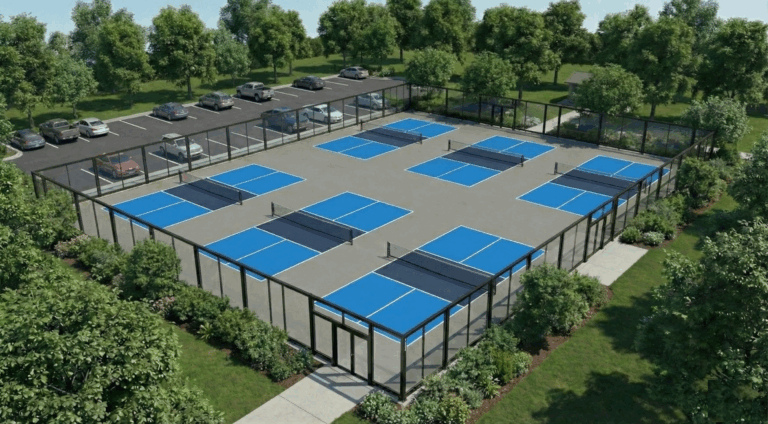
About PICKLETILE™
PICKLETILE™ is the leading design-build firm for premium pickleball court construction and the Official Court Builder of USA Pickleball.
Headquartered in Austin, Texas, PICKLETILE™ simplifies the complex construction process by offering turnkey solutions for residential, commercial, and club-level projects. The company is also the creator of PICKLEGLASS™, a patented soundproof glass wall system engineered to reduce noise by 50% while offering panoramic views and wind protection. For more information, visit www.pickletile.com.
