
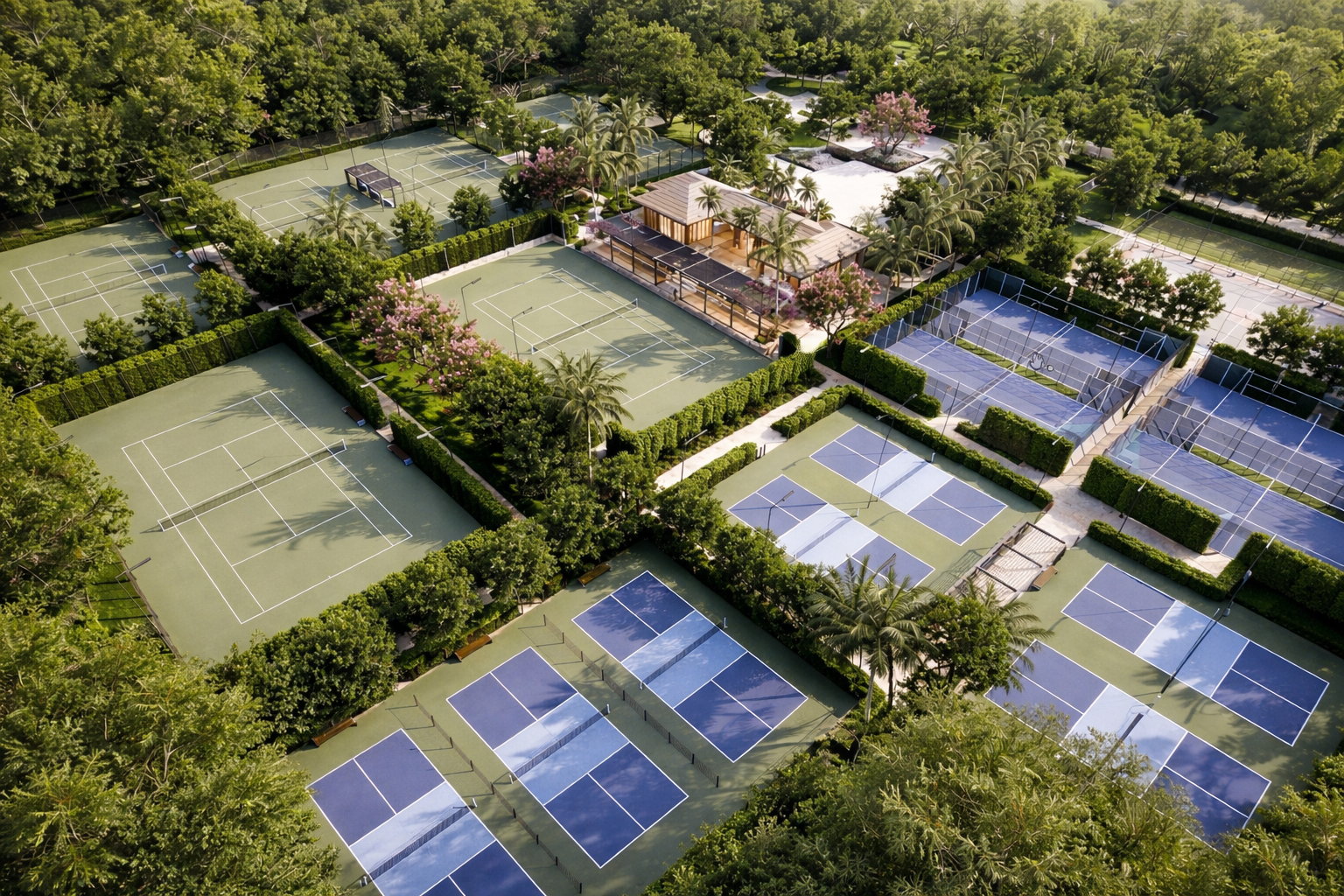
We work with a lot of developers at a wide range of project scales. How do you compare?
AUSTIN, Texas – Apr. 2, 2026 – We work with multifamily developers across a range of project sizes, and there are clear patterns in how court amenities are being scoped based on unit count, market positioning, and site conditions. Here’s what we’re seeing:
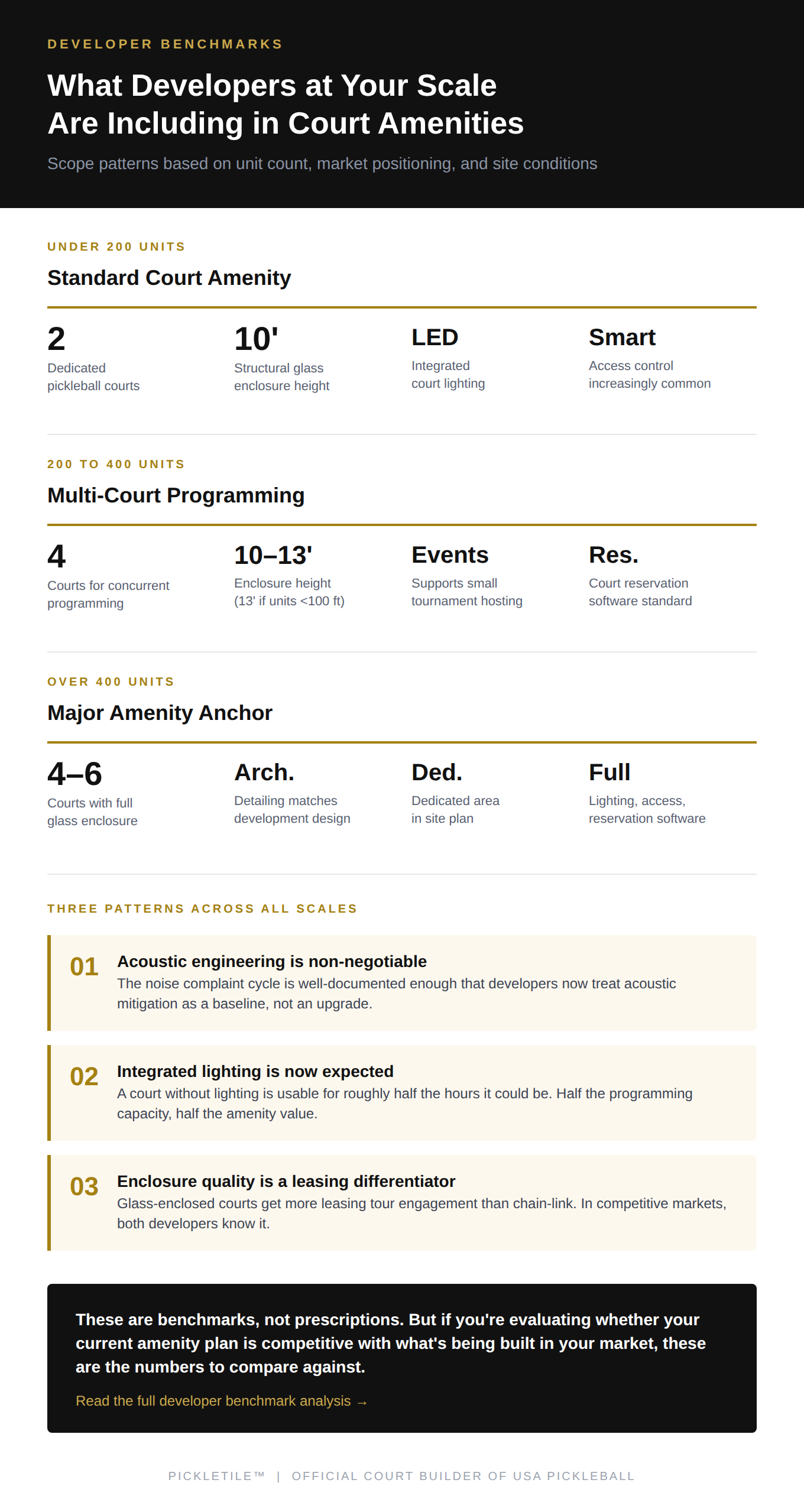
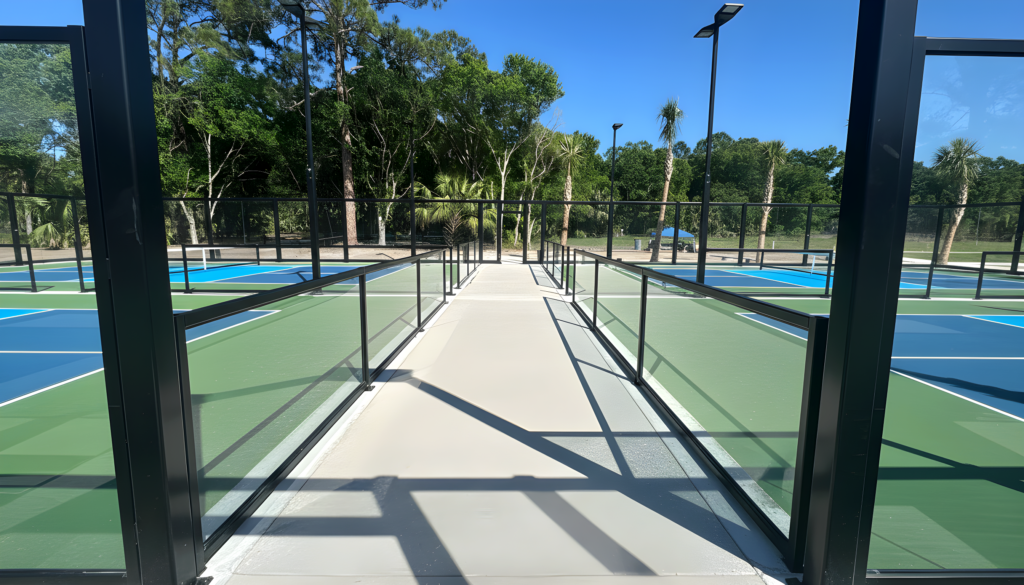
Projects under 200 units typically include 2 dedicated pickleball courts with a 10-foot structural glass enclosure, integrated LED lighting, and professional-grade sport surfacing. The enclosure provides acoustic protection for adjacent units, wind control for consistent playing conditions, and an architectural presence that elevates the amenity beyond a basic court. Smart access systems are increasingly common, allowing property managers to control court availability and enable resident reservations without staff.
Projects between 200 and 400 units are trending toward 4 courts, enough to support concurrent programming (resident events, reserved play, and open court time simultaneously) without scheduling conflicts. The 4-court configuration also supports small tournament hosting, which is becoming a community activation tool for property managers. Acoustic enclosure height at this scale is typically 10 feet minimum, with 13 feet specified when residential units are within 100 feet of the courts.
Projects over 400 units are treating the court facility as a major amenity anchor, comparable to the pool or fitness center in budget allocation and design attention. 4 to 6 courts, full glass enclosure, integrated lighting, smart access with court reservation software, and architectural detailing that matches the development’s design language. At this scale, the court facility often has its own dedicated area in the site plan rather than being placed in residual space.
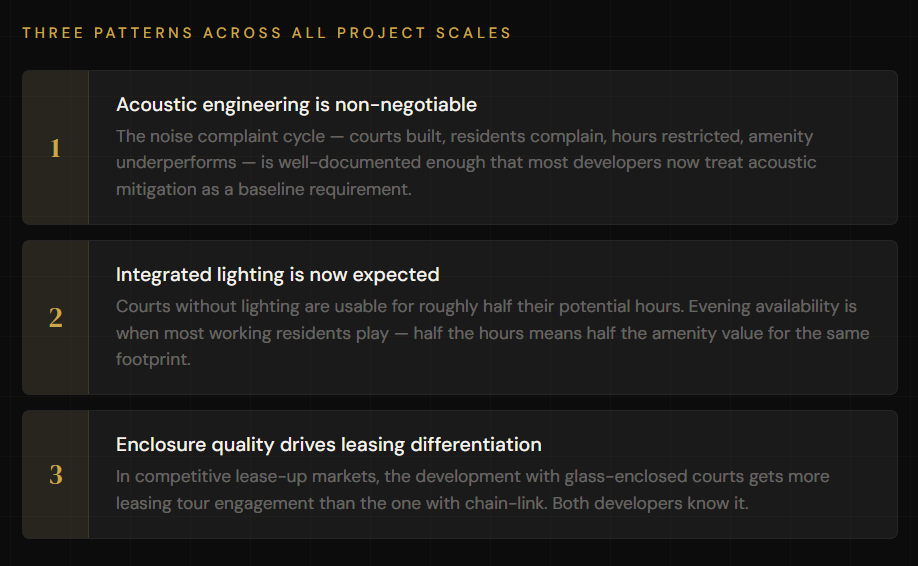
Three patterns worth noting across all scales:
First, acoustic engineering is becoming non-negotiable for any project that places courts near residential units. The noise complaint cycle (courts built, residents complain, hours restricted, amenity underperforms) is well-documented enough that most developers now treat acoustic mitigation as a baseline requirement, not an optional upgrade.
Second, integrated lighting is shifting from “nice to have” to “expected.” Residents use courts in the evenings, because that’s when most working adults are available to play. A court without lighting is a court that’s usable for roughly half the hours it could be, which means half the programming capacity and half the amenity value for the same construction footprint.
Third, the quality of the enclosure system is increasingly visible in competitive leasing. Developers in markets where multiple new projects are launching simultaneously are using the court facility as a point of differentiation. The development with glass-enclosed courts gets more leasing tour engagement than the one with chain-link. Both developers know it.
Where your project fits:
These are general benchmarks, not prescriptions. Your project may have site constraints, budget parameters, or market positioning that shifts the right scope in one direction or another. But if you’re evaluating whether your current amenity plan is competitive with what’s being built in your market, these are the numbers to compare against.
About PICKLETILE™
PICKLETILE™ is the leading design-build firm for premium pickleball court construction and the Official Court Builder of USA Pickleball.
Headquartered in Austin, Texas, PICKLETILE™ simplifies the complex construction process by offering turnkey solutions for residential, commercial, and club-level projects. The company is also the creator of PICKLEGLASS™, a patented soundproof glass wall system engineered to reduce noise by 50% while offering panoramic views and wind protection. For more information, visit www.pickletile.com.
