The best canopy for a tennis or pickleball facility is a PTFE tensile membrane system: weatherproof, Class A non-combustible, self-cleaning, with a 30+ year design life and 10 to 50% diffused daylight that improves play. Judge any sports canopy against five criteria, lifespan, fire rating, daylight quality, weather protection, and structure, and a PTFE membrane on a hot-dip galvanized steel frame outperforms steel-shade and woven-cloth options on every one. The right span engineering then differs for tennis versus pickleball.
01What “best” actually means for a facility
“Best” is not the most shade for the least money. For a facility that intends its courts to be a lasting amenity, best means the canopy that keeps performing as an asset for decades, passes the reviews that approve the project, and improves how the space plays. A cover that wins on day-one price and loses on every other axis is not best; it is cheapest, and those are different decisions.
So the productive way to choose is to fix the criteria first, then see where each option lands against them. Five criteria do almost all the work. Get them right and the material answer follows; skip them and you are buying on price alone, which is how facilities end up replacing a cover twice in the time a good one would still be standing.
02The five criteria that matter
Lifespan. How long will it perform before replacement? A PTFE membrane is engineered for a 30+ year design life, where PVC typically reaches roughly 15 to 20 years and shade cloth roughly 7 to 12. Over an ownership horizon, this is the single biggest separator. Fire rating. Many institutional, municipal, and hospitality projects require a non-combustible roof; PTFE-coated fiberglass is Class A and non-combustible, which is frequently the line that decides approval. Daylight quality. A canopy should not trade weather for darkness; PTFE transmits 10 to 50% of natural light as soft, diffused daylight, giving even, glare-reduced visibility and cutting daytime lighting load. Weather protection. A real sports canopy is weatherproof, not porous; shade cloth lets rain through, while a PTFE membrane provides full overhead cover. Structure. The frame must match the membrane’s permanence; a hot-dip galvanized steel frame resists corrosion for decades so the system does not rust out under a long-life roof.
| Criterion | PTFE membrane | PVC / PVDF | Shade cloth / steel-shade |
|---|---|---|---|
| Lifespan | 30+ years | ~15 to 20 years | ~7 to 12 years |
| Fire rating | Class A, non-combustible | Combustible base | Combustible |
| Daylight | 10 to 50% diffused | Translucent, can discolor | Blocks light, no quality |
| Weather | Permanent, weatherproof | Weatherproof, shorter life | Porous, not weatherproof |
| Structure | Hot-dip galvanized steel | Varies | Often painted, rusts at joints |
03Why architectural membrane beats steel-shade and cloth
Once the criteria are set, the reason a tensile membrane wins is that it is a different category of product. A woven shade cloth or a steel-shade panel system is designed to block sun; it is not engineered as a permanent building element. An architectural PTFE membrane is. It is the material specified for stadiums, airports, and landmark civic structures precisely because it carries decades of weather, fire, and structural demand without degrading.
That is why the comparison is not really membrane versus membrane; it is permanent architecture versus a consumable. For the full material breakdown across PTFE, PVC, and shade cloth, see our guide on choosing a canopy material. The short version: a facility that wants a canopy to look and perform like part of the building should specify a membrane that is one.
04Tennis versus pickleball: the span question
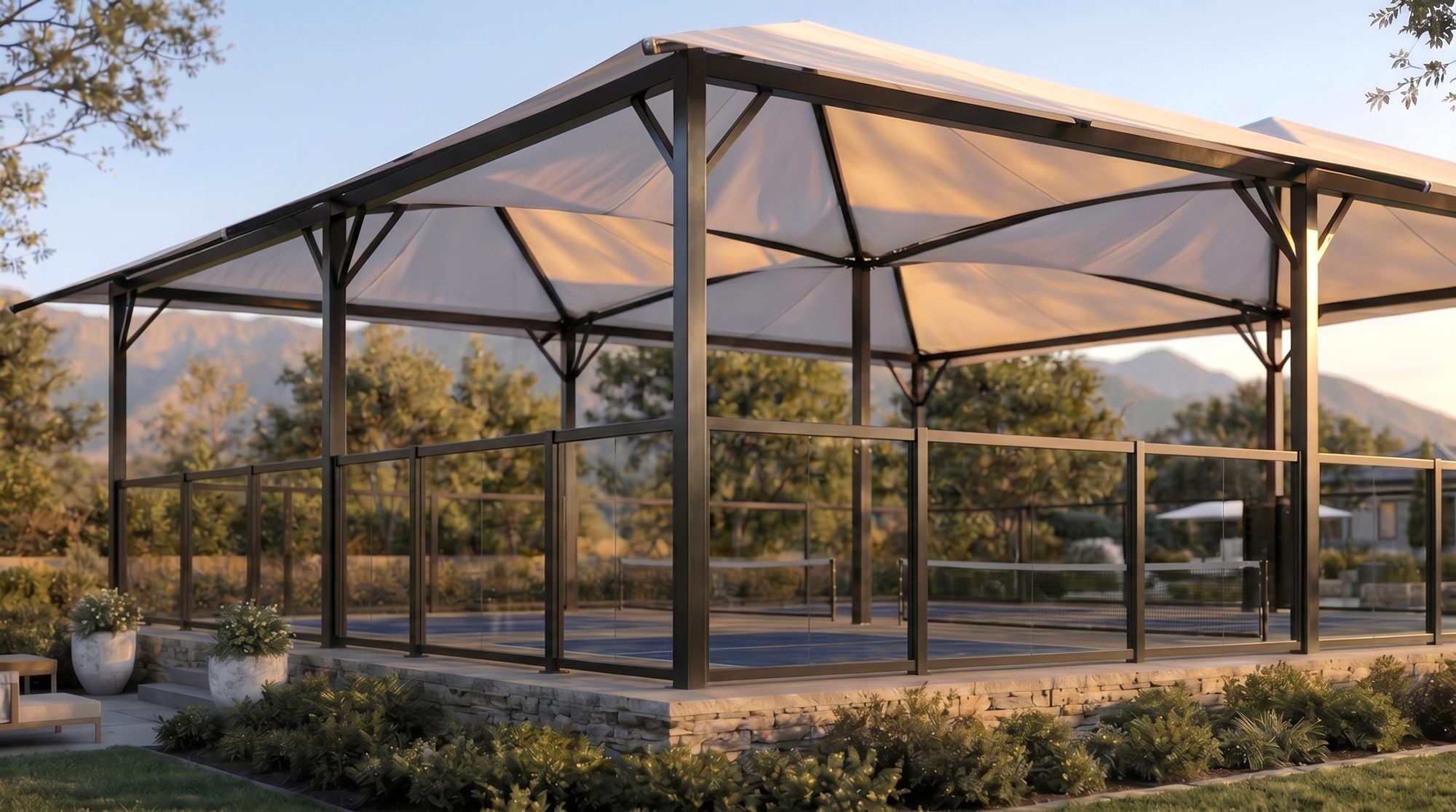
The criteria are the same across both sports, but the engineering is not, and span is the main reason. A tennis court is substantially larger than a pickleball court, so a tennis canopy must cross a wider clear span, the column-free distance the roof spans, which raises the structural demand and the frame sizing. A pickleball-only facility can often be covered with a tighter, more efficient structure, while a multi-sport facility covering tennis, or tennis and pickleball under one roof, needs heavier members and more deliberate geometry.
This matters for two reasons. First, it is a real cost and engineering driver, so a credible canopy is engineered to your actual sport mix and layout rather than sold as a one-size kit. Second, it underlines why site-specific engineering is non-negotiable: the same membrane has to be tensioned and supported differently across a wide tennis span than across a compact pickleball court, and getting that wrong is what shortens a canopy’s life. For how that engineering is done to wind and snow loads, see our wind and snow engineering guide.
05The engineered option, in one system
Measured against all five criteria, the best canopy for a serious tennis or pickleball facility is an engineered PTFE membrane on a galvanized steel frame, designed to the site’s loads and the facility’s sport mix. The PICKLEGLASS™ CANOPY is that system: a 30+ year design life, Class A non-combustible membrane, 10 to 50% diffused daylight, and a hot-dip galvanized frame, engineered with PE-stamped structural calculations and built to complete the PICKLEGLASS™ envelope of walls and roof.
The reason to frame the decision this way is that it protects the facility from buying on the wrong axis. A canopy chosen on price is a canopy chosen on the one criterion that matters least over thirty years. A canopy chosen on the five criteria above is one that is still an asset when the budget covers have been replaced twice.
- Judge on five criteria. Lifespan, fire rating, daylight quality, weather protection, and structure, not on day-one price.
- PTFE membrane wins each one. A 30+ year design life, Class A non-combustible, 10 to 50% diffused daylight, weatherproof, on a galvanized frame.
- Membrane is a different category. Architectural PTFE is a permanent building element; shade cloth and steel-shade are consumables that block sun.
- Span differs by sport. Tennis spans wider than pickleball, so a credible canopy is engineered to your actual sport mix, not sold as a kit.
FAQFrequently asked questions
What is the best canopy for a tennis or pickleball facility?
A PTFE tensile membrane system on a hot-dip galvanized steel frame: weatherproof, Class A non-combustible, self-cleaning, with a 30+ year design life and 10 to 50% diffused daylight. It outperforms PVC membrane and shade cloth on lifespan, fire, daylight, weather, and structure.
What should I look for in a sports canopy?
Five criteria: lifespan, fire rating, daylight quality, weather protection, and the structure underneath. A serious canopy is engineered for decades, carries a non-combustible rating, diffuses daylight, is weatherproof, and sits on a corrosion-resistant frame.
Why is a membrane canopy better than shade cloth?
An architectural PTFE membrane is a permanent building element engineered for 30+ years, while shade cloth and steel-shade panels are consumables designed only to block sun. The membrane is weatherproof, non-combustible, and self-cleaning where shade cloth is porous and fades within roughly 7 to 12 years.
Is a tennis court canopy different from a pickleball canopy?
The selection criteria are identical, but the engineering differs. A tennis court is larger, so a tennis canopy crosses a wider clear span and needs heavier structural members, which is why a credible canopy is engineered to the facility’s actual sport mix and layout.
Does a canopy provide enough light to play under?
Yes. A PTFE membrane transmits 10 to 50% of natural light as soft, diffused daylight, giving even, glare-reduced visibility on the court and reducing the need for daytime lighting, so play is comfortable rather than dark.