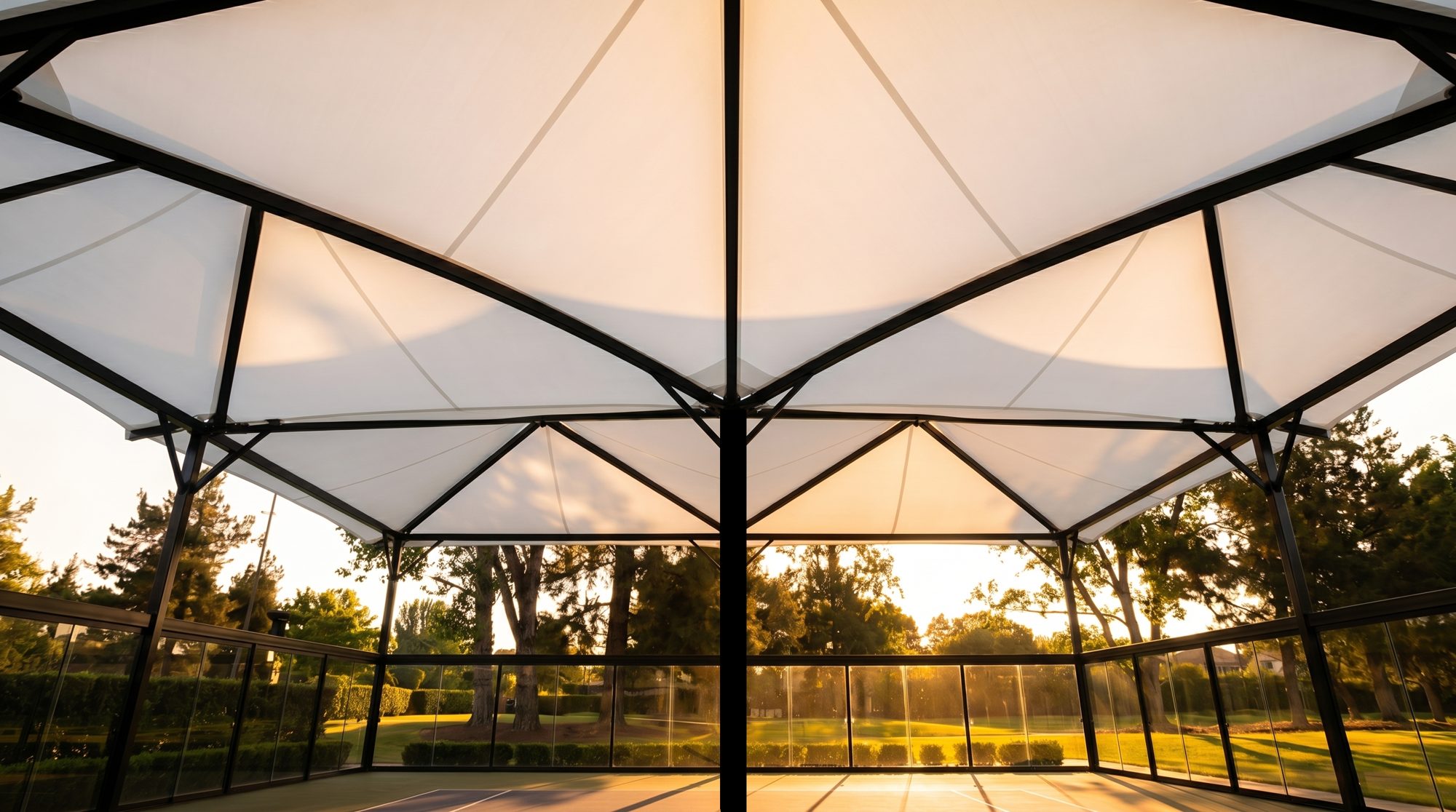
A properly engineered court canopy is designed to site-specific wind and snow loads, not built from a one-size kit. That means a wind load analysis driving the anchorage, foundation, and membrane pretensioning; snow-shedding roof geometry with controlled deflection and member sizing for the local snow load; engineered foundations based on a geotechnical analysis; corrosion protection sized for the climate; and code-compliant, PE-stamped structural calculations. The membrane and the frame are designed together so the system performs across a 30+ year design life.
01Why “engineered to the site” is the whole answer
The question behind “will it hold up to wind and snow” is really a question about whether the canopy was engineered or assembled. A kit sold to a fixed specification cannot know your site’s design wind speed, your ground snow load, or your soil’s bearing capacity, so it either over-builds everywhere or, more dangerously, under-builds where it matters. A canopy engineered to the site starts from those numbers and sizes the structure to them.
This is the line between a permanent building structure and a recreational cover. The codes that govern permanent structures, and the engineers who stamp them, require that the design respond to the actual environmental loads of the location. Everything below follows from that single principle: the loads are local, so the engineering must be too.
02Wind: analysis, anchorage, pretensioning, redundancy
Wind acts on a canopy as both downward pressure and, critically, uplift, the suction that tries to lift the roof off its supports. Engineering for it begins with a site-specific wind load analysis using the local design wind speed and exposure, which sets the forces every member and connection must resist. From there, four things are designed in concert.
Anchorage and foundations are sized to resist uplift, so the structure stays tied to the ground under the worst design gust. Membrane pretensioning is optimized so the fabric is taut enough not to flutter and fatigue under wind, a loose membrane is a membrane that fails early. Structural redundancy and load distribution mean the frame shares load across members rather than concentrating it, so no single connection is the lone point of failure. And the whole assembly is designed to be code compliant, which is what makes it permittable as a permanent structure. The result is a roof that treats wind as a calculated load, not a hope.
The input
The response
03Snow: shedding geometry, deflection, member sizing
Snow is a sustained vertical load, and the danger is accumulation: snow that sits and builds adds weight a roof must either carry or shed. Engineering for it likewise starts with a site-specific analysis of the local ground snow load. The first line of defense is snow-shedding roof geometry: a membrane roof is shaped and pitched so snow slides off rather than ponding, which reduces the peak load the structure ever sees.
Where snow will still accumulate, the structure is designed to carry it safely. Controlled deflection means the frame and membrane are sized so they flex within engineered limits under load and return, rather than deforming permanently or pooling water. Optimized member sizing and spacing match the steel to the calculated snow load so the structure is strong where it needs to be without wasteful over-building. Together, shedding geometry and load-rated members give a canopy winter-climate reliability rather than a seasonal gamble.
04Foundations and corrosion in harsh climates
A canopy is only as stable as what it stands on, so foundations are engineered to the site rather than assumed. That means a geotechnical and soil-bearing analysis to confirm the ground can carry the loads, plus design for settlement mitigation so the structure does not shift unevenly over time, and uplift and anchoring resistance so wind cannot pull the structure free. Poor or variable soil is not a reason to skip this; it is the reason it exists.
Harsh climates attack the frame as well as the roof, which is why the steel matters. PICKLEGLASS™ CANOPY uses a hot-dip galvanized steel frame with a 75 to 100 micron zinc layer that is metallurgically bonded to the steel. It protects in two ways at once, a dense barrier sealing the steel and sacrificial cathodic protection at any scratch, which is why it holds up in coastal salt air, high humidity, desert temperature swings, industrial atmospheres, and acid-rain zones where a painted finish would chip and rust. The corrosion strategy is matched to the climate, not assumed away.
| Load or condition | Engineered response |
|---|---|
| Wind pressure and uplift | Site wind analysis, anchorage, pretensioning, redundancy |
| Snow accumulation | Shedding geometry, controlled deflection, member sizing |
| Soil and settlement | Geotechnical analysis, settlement mitigation, anchoring |
| Corrosive climate | Hot-dip galvanized steel, 75 to 100 micron zinc layer |
| Permitting | Code-compliant, PE-stamped structural calculations |
05Code compliance and PE-stamped calculations
For a permanent, permitted structure, the engineering has to be documented and signed, not just performed. That is where PE-stamped structural calculations come in: a licensed professional engineer reviews and stamps the wind load analysis, snow load analysis, foundation requirements, and member design, certifying that the structure meets code for its specific site. For the canopy, which is a permitted permanent structure, these stamped calculations are part of permitting delivery, an in-house capability provided when a project requires it, not a marketing freebie bolted onto every product.
For an architect or engineer specifying a court canopy, this is the real proof. The credibility of a canopy is not a brochure claim about being “built tough”; it is the depth of the engineering behind it, site-specific load analysis, foundation design, corrosion protection, and stamped calculations that a building department will approve. That full engineered system is the PICKLEGLASS™ CANOPY, the roof that completes the PICKLEGLASS™ envelope. For how span requirements differ by sport, see our guide on choosing a canopy for tennis and pickleball facilities.
- Engineered to the site, not a kit. Wind and snow loads are local, so the structure must be designed to them.
- Wind is a calculated load. Site analysis drives anchorage against uplift, membrane pretensioning, and structural redundancy.
- Snow geometry comes first. A shedding roof profile lowers peak load, then controlled deflection and member sizing carry the rest.
- Foundations and corrosion are engineered too. Geotechnical analysis plus a hot-dip galvanized frame for harsh climates, all certified by PE-stamped calculations.
FAQFrequently asked questions
Will a court canopy hold up to high wind?
A properly engineered canopy is designed to a site-specific wind load analysis, with anchorage and foundations sized to resist uplift, optimized membrane pretensioning, and structural redundancy so load is distributed rather than concentrated, all code-compliant for the location.
Can a tensile canopy handle snow load?
Yes, when engineered for it. The roof uses snow-shedding geometry so snow slides off rather than ponding, and the structure is designed with controlled deflection and member sizing matched to the local ground snow load for winter-climate reliability.
Are the foundations engineered for the site?
Yes. Foundations are based on a geotechnical and soil-bearing analysis, with design for settlement mitigation and uplift and anchoring resistance, so the structure stays stable on the actual soil conditions rather than an assumed standard.
How is the frame protected in coastal or harsh climates?
With a hot-dip galvanized steel frame carrying a 75 to 100 micron zinc layer metallurgically bonded to the steel. It combines a dense barrier with sacrificial cathodic protection, so it resists corrosion in coastal, humid, desert, industrial, and acid-rain environments.
Does the canopy come with PE-stamped structural calculations?
For the canopy, a permitted permanent structure, PE-stamped structural calculations are part of permitting delivery, available in-house when a project requires them. They certify the wind load, snow load, foundation, and member design meet code for the specific site.