A well-designed racquet sports court influences property value in two different ways. On a single residence, a court rarely appraises dollar-for-dollar against its cost; its value shows up in marketability, buyer pool, and time-on-market. On income-producing property such as an apartment community, club, or resort, a court is valued the way every other amenity is valued: through its effect on net operating income, rents, dues, retention, and absorption. The deciding factor is not whether a court exists, but whether it was built as permanent, code-stamped, acoustically controlled infrastructure or as a temporary feature that ages into a liability.
01The two valuation models you need to separate
The single most common mistake in court investment is applying residential intuition to a commercial asset, or commercial math to a private home. They are governed by different rules.
Owner-occupied property is valued on marketability. An appraiser working a single-family residence will rarely assign a court its full installed cost as added value. What a high-quality court does instead is widen the buyer pool, differentiate the listing, and shorten time-on-market. For estates competing in a thin luxury segment, a permanent, architecturally integrated court can be the feature that moves a property from “considered” to “sold.” The value is real, but it lives in liquidity and desirability rather than on the appraisal line.
Income property is valued on net operating income. For a developer, an asset manager, a club, or a resort, the court is an amenity whose value flows through the capitalization of income. A court that lifts rents, raises dues, improves tenant or member retention, accelerates lease-up, or generates programming revenue increases NOI, and at a given cap rate that increase is multiplied directly into asset value. This is why the same court can be a marketing nicety in one context and a measurable capital improvement in another.
Owner-occupied
Income property
| Property type | How value is measured | What the court has to do |
|---|---|---|
| Private estate | Marketability, buyer pool, time-on-market | Architecturally integrated, permanent, quiet enough for a residential setting |
| Community / HOA | Lot premiums, absorption, resident satisfaction | Approved, durable, low-complaint, low-maintenance for decades of shared use |
| Multifamily | NOI through rents, retention, lease-up velocity | Differentiating amenity that does not generate noise complaints from adjacent units |
| Country club | Membership demand, dues, capital-improvement value | Premium member experience that protects the club’s reputation and aesthetic |
| Hospitality / resort | NOI through length of stay, programming | Revenue-generating amenity that performs in coastal and all-weather conditions |
| Municipal / parks | Lifecycle cost, public use, regulatory durability | Code-stamped, permit-ready, built for heavy public use without complaint risk |
02Why permanent infrastructure protects value
An amenity only adds value if it is still an asset in year ten. This is where the distinction between engineered infrastructure and a temporary court becomes financial rather than aesthetic.
Temporary acoustic tarps, screen systems, and lower-grade enclosures degrade visibly: they sag, fade, tear, and rust. An independent analysis found that traditional sound tarps cost roughly 30% more to own over ten years once replacement and maintenance are counted. A degrading court does not hold value at the level it was installed; it becomes deferred maintenance that a future buyer, board, or asset manager discounts against the property.
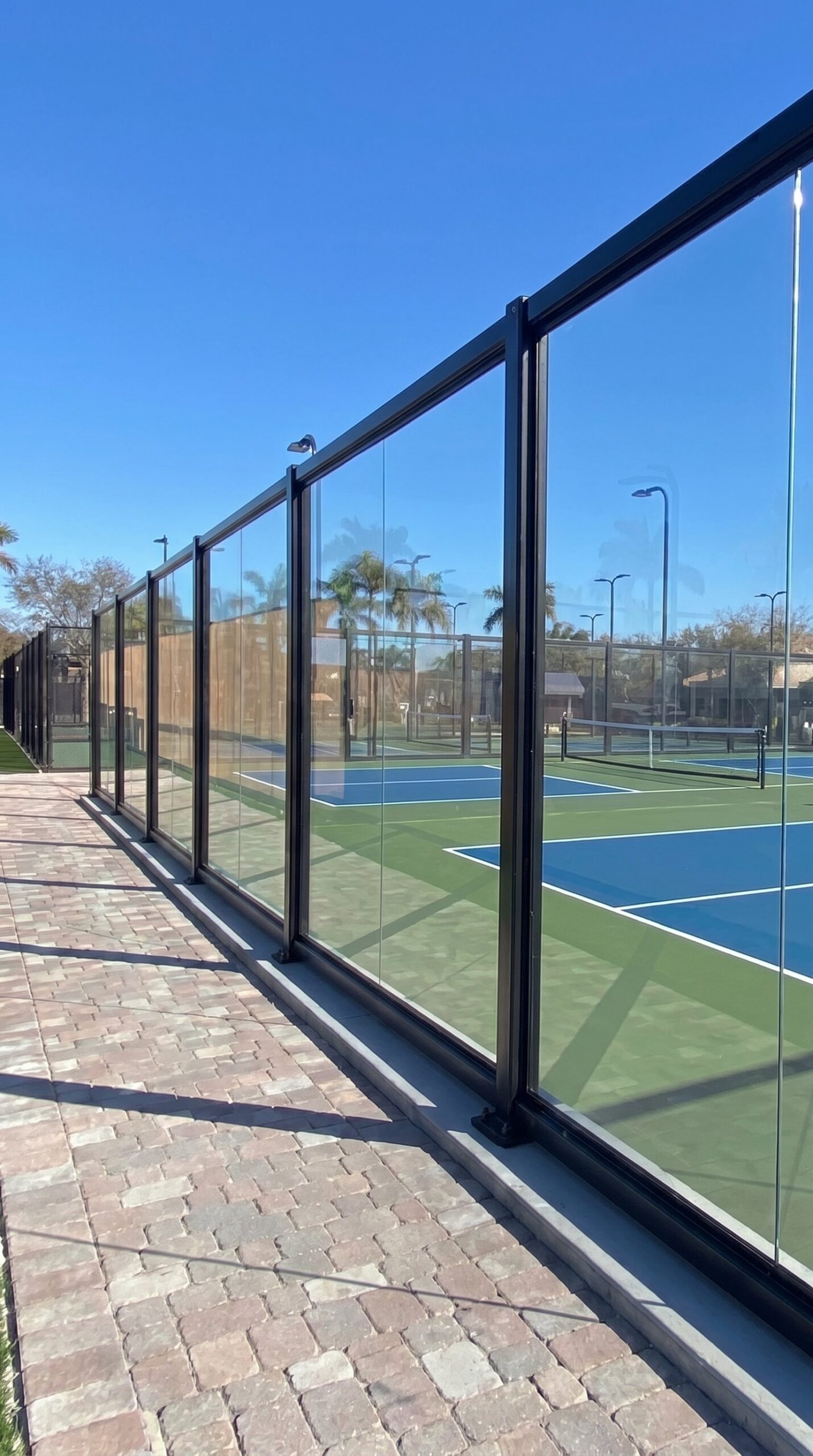
PICKLEGLASS™ carries a 10-year no-rust guarantee with no geographic carve-outs, an AAMA 2605 super-durable powder coat, and an EnduroShield coating that reduces maintenance by up to 90%. The glass is rated to up to 200 mph (ASCE 7-22) wind load and offers 92%+ optical clarity. A court built to those standards is still presenting as a premium asset when it is appraised, sold, or refinanced years later.
03The hidden value lever: noise
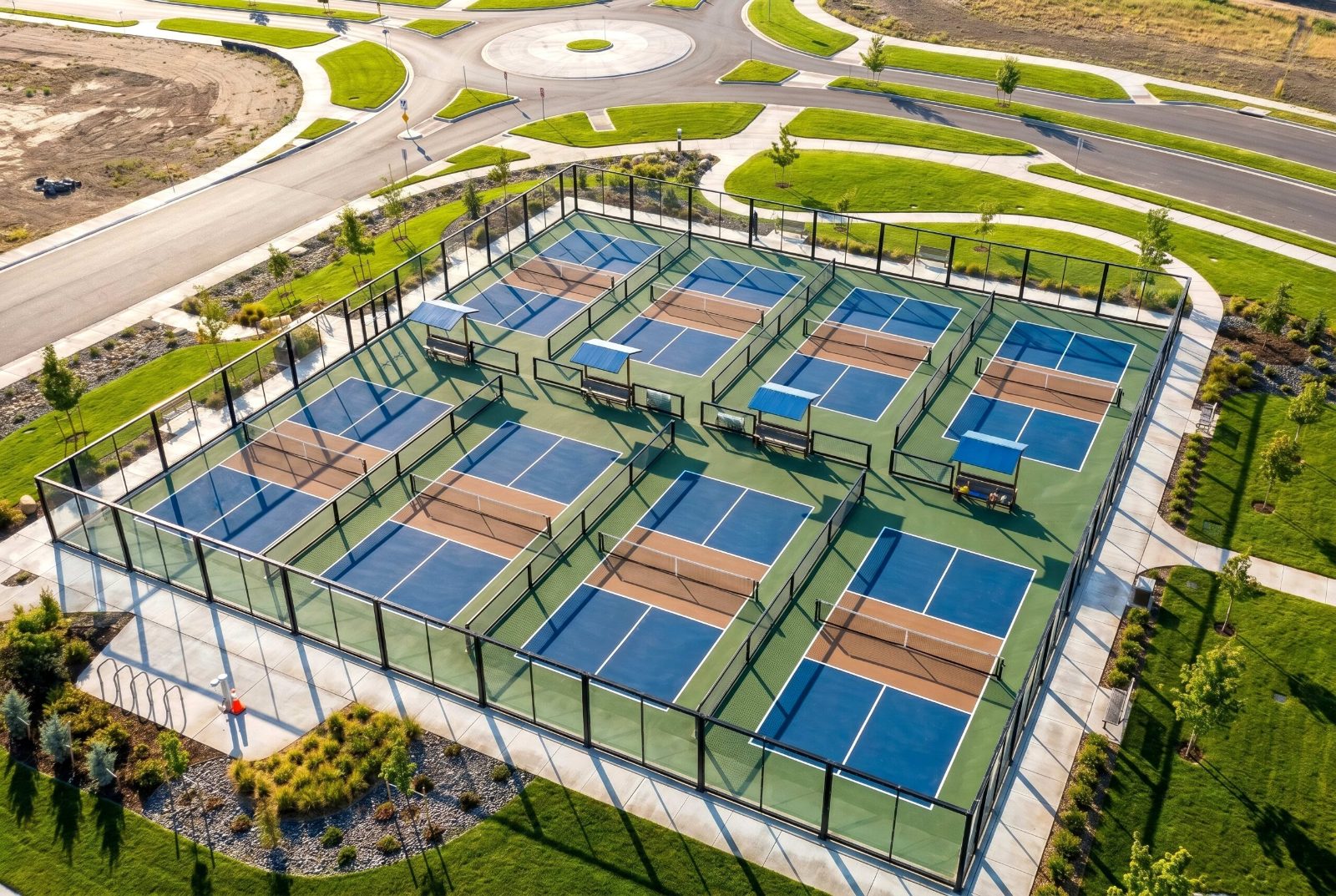
Noise is the variable that most often turns a court from an asset into a liability, and it is the one most owners underestimate. Pickleball’s impact sound concentrates near 1,600 Hz, a frequency the human ear is unusually sensitive to and that ordinary distance and standard barriers do not adequately control. When a court sits near homes, units, or guest rooms, unmanaged noise produces complaints, restricted playing hours, regulatory pressure, and in residential settings, suppressed value for the adjacent properties most exposed to it.
This is why acoustic performance is a property-value issue, not just a comfort issue. PICKLEGLASS™ is rated at STC 36 and reduces perceived noise by up to 16 dBA, experienced as up to roughly 65% quieter at the peak, per an independent environmental noise study by Trinity Consultants and Cerami Longman Lindsey (2025) tuned to the pickleball impact frequency. A court that can run full hours without generating complaints preserves the amenity’s value and protects the value of everything around it. Review the full acoustic data on the sound suppression page and the enclosure system on the PICKLEGLASS™ page.
04Approval risk is value risk
A court that cannot be approved, or that gets shut down after the fact, is not a zero on the balance sheet; it is a negative. Entitlement and permitting risk is real in residential, HOA, and municipal contexts, and it is almost always driven by noise and structural review. PICKLETILE delivers PE-stamped drawings on every project and reports a 100% permit success rate across submitted projects to date. For a developer or a board, that de-risking is part of the value: an amenity that clears review and survives community scrutiny is a capital improvement, while one that triggers litigation or a use restriction is impaired from day one.
| Decision | Value-protecting | Value-eroding |
|---|---|---|
| Enclosure | Acoustic-rated structural glass enclosure system (STC 36) | Open court or temporary screen near occupied buildings |
| Durability | 10-year no-rust, AAMA 2605, up to 90% less maintenance | Tarps and screens that fade, sag, and need replacement |
| Approval | PE-stamped drawings, designed to clear review | Unpermitted or under-engineered build exposed to shutdown |
| Lifecycle cost | Single-source engineered system with a known cost curve | Lowest-bid assembly that costs roughly 30% more to own over 10 years |
05How to make the value case to a decision-maker
The framing changes with who signs. For a developer or asset manager, connect the court to NOI: the rent or dues lift, the retention or absorption effect, and the cap-rate multiplication that follows. For a club president or general manager, connect it to membership demand and the club’s reputation. For a municipality, lead with lifecycle cost and the durability that withstands public use without complaint. For a private owner, lead with marketability and a court that looks as good as it plays. In every case, the engineering, the acoustic rating, and the approval record are what separate a durable capital asset from a depreciating feature.
- Owner-occupied property gains value through marketability; income property gains value through NOI. Use the right model for the asset.
- A court is only an asset in year ten if it was built as permanent infrastructure. Temporary systems cost roughly 30% more to own over 10 years and depreciate as deferred maintenance.
- Noise is a value lever. An acoustic-rated enclosure (STC 36, up to 16 dBA, up to ~65% quieter) protects the amenity and the property around it.
- Approval risk is value risk. PE-stamped drawings and a 100% permit success rate to date turn a court into a capital improvement rather than a liability.
FAQFrequently asked questions
Does a pickleball court increase property value?
It depends on the property type. On a single residence, a court usually increases marketability and shortens time-on-market rather than appraising for its full installed cost. On income property such as a multifamily community, club, or resort, a court increases value by raising net operating income through rents, dues, retention, and programming revenue, which is then multiplied into asset value at the property’s cap rate.
How much value does a pickleball court add to a home?
There is no fixed dollar figure, and any source that quotes one in isolation is overstating it. For an owner-occupied home, the value shows up as a wider buyer pool and faster sale, not as a one-to-one return on the appraisal. The amount depends on the local luxury market, the quality and permanence of the build, and whether the court is quiet enough to be an asset rather than a nuisance to the next owner.
Do pickleball courts hurt property value because of noise?
An unmanaged court near homes can suppress the value of the most exposed adjacent properties and trigger complaints, restricted hours, or use restrictions. An acoustic-rated enclosure changes that calculation. PICKLEGLASS™ is rated at STC 36 and reduces noise by up to 16 dBA, experienced as up to roughly 65% quieter at the peak, which allows a court to operate without generating the complaints that erode value.
How does a court affect the value of an apartment community?
Through NOI. A differentiating amenity supports higher rents, improves tenant retention, and accelerates lease-up, all of which raise net operating income. At a given cap rate, that NOI increase capitalizes directly into asset value. The condition is that the court must not generate noise complaints from adjacent units, which is why an acoustic-rated enclosure matters more in multifamily than almost anywhere else.
What makes a court an asset rather than a liability?
Permanence, approval, and acoustic control. A court built as engineered infrastructure with PE-stamped drawings, a 10-year no-rust guarantee, and a verified acoustic rating remains a premium asset for years. A temporary or unpermitted court degrades, invites complaints, and is discounted by future buyers, boards, and asset managers as deferred maintenance or unresolved risk.
Does an enclosed glass court hold value better than an open court?
In any setting near occupied buildings, yes, for two reasons. An acoustic-rated structural glass enclosure system controls the noise that otherwise restricts use and depresses adjacent value, and its engineered durability (AAMA 2605 finish, up to 200 mph wind rating, up to 90% less maintenance) means it still presents as a premium asset when the property is appraised or sold.