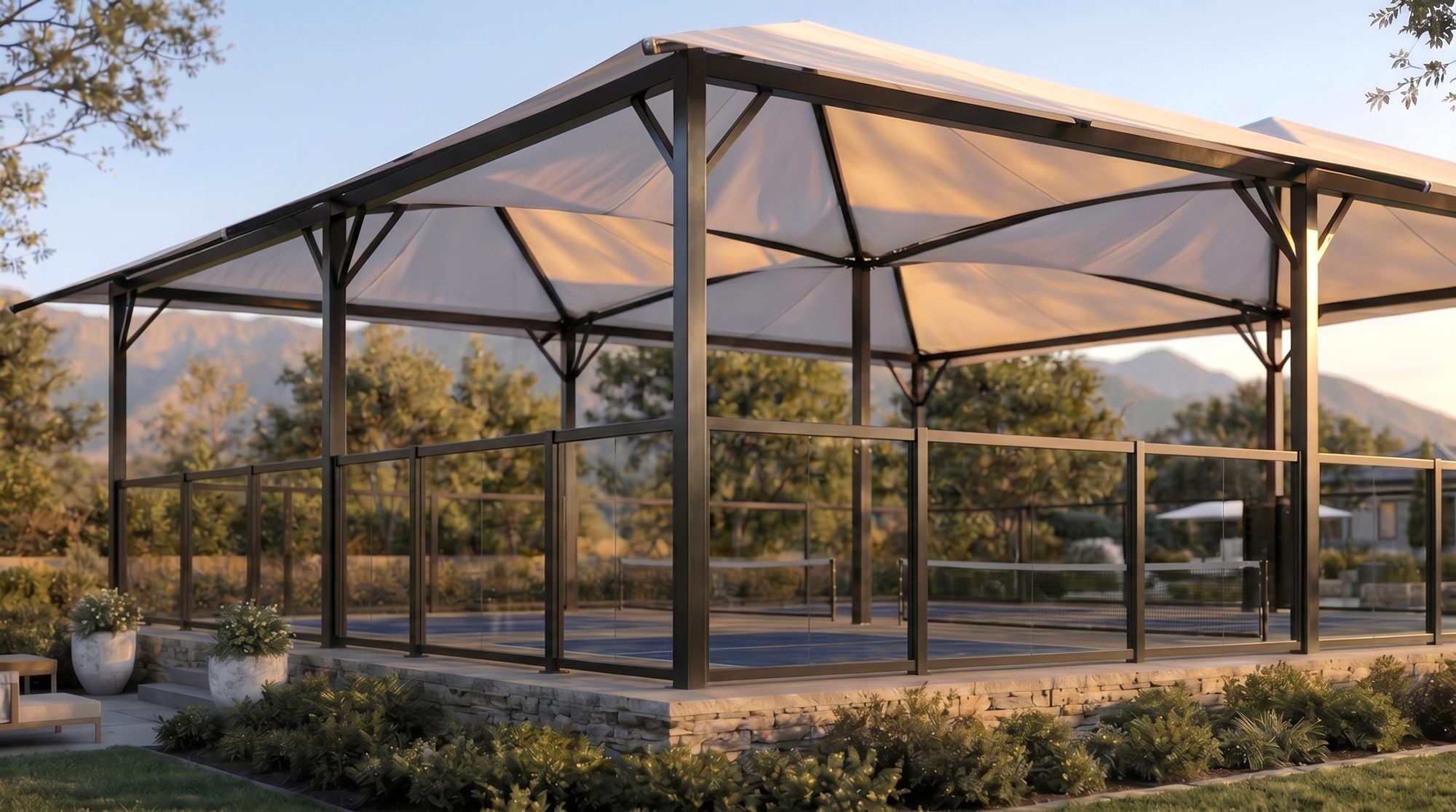
A PTFE tensile membrane canopy is engineered for a 30+ year design life, among the longest of any architectural membrane, and the PICKLEGLASS™ CANOPY is backed by a 10-year warranty. By comparison, PVC or PVDF membrane typically lasts roughly 15 to 20 years, and HDPE shade cloth typically fades and sags within 7 to 12 years. PTFE lasts because the coating is chemically inert, UV-stable, and self-cleaning, and because it sits on a hot-dip galvanized steel frame engineered to match its permanence.
01The direct answer, and what it means
A PTFE-coated fiberglass membrane is engineered for a 30+ year design life. That is not a marketing round number; it is the service horizon the material class is specified to on stadiums, airports, and landmark civic structures, where replacement is not a casual option. For a racquet facility, that means a canopy installed today is engineered to still be performing as an asset three decades from now.
Put that next to the alternatives and the gap is the whole story. PVC or PVDF membrane typically reaches roughly 15 to 20 years before it discolors and weakens. HDPE shade cloth, the woven mesh sold as low-cost shade, typically fades and sags within roughly 7 to 12 years. Over a 30-year ownership window, those materials are bought again, and again, while a PTFE system is built once.
02Why PTFE lasts as long as it does
The lifespan is not luck. It comes from four properties of the material working together. First, the PTFE coating is chemically inert and one of the most weather-stable polymers available, so it resists UV breakdown, airborne chemicals, acid rain, and pollution that degrade lesser fabrics. Second, the woven fiberglass base gives the membrane high tensile strength, creep resistance, and long-term dimensional stability, so it holds its tension and shape across decades instead of stretching out.
Third, the surface is self-cleaning. PTFE is naturally non-stick, so ordinary rainfall carries dirt and contaminants off the membrane rather than letting them bond to it. The canopy keeps its bright finish with near-zero maintenance, and the absence of accumulated grime is part of why it does not visibly age. Fourth, the membrane is Class A non-combustible, which reflects how thermally and chemically stable the material is, not just a fire-code line item. Together these mean the canopy is not slowly failing the day it goes up.
03Design life vs warranty, stated honestly
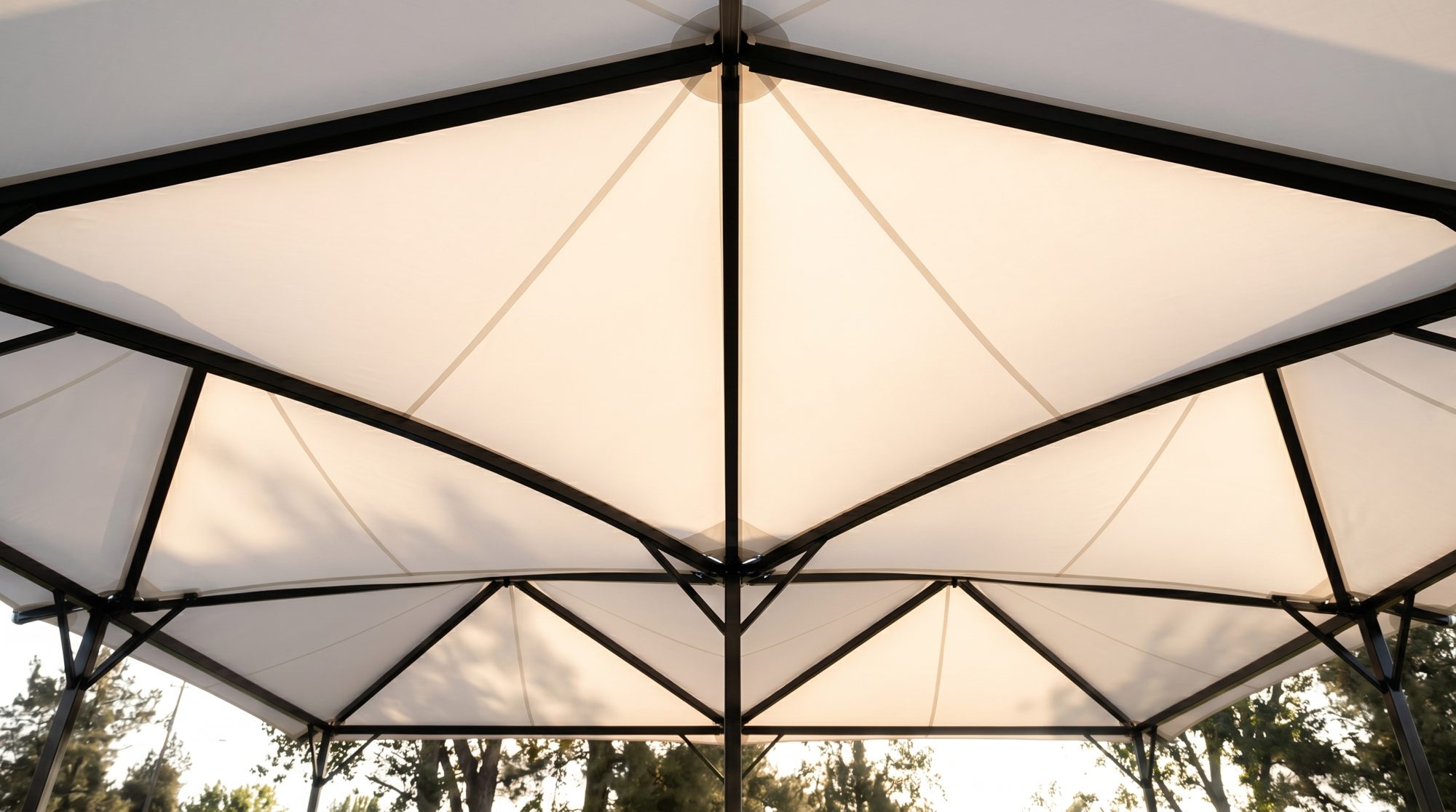
These two numbers get confused, so it is worth separating them plainly. Design life is the period the system is engineered to perform across, based on the material science and the structural engineering: 30+ years for a PTFE membrane on a galvanized frame. Warranty is the contractual period the product is guaranteed against defects: a 10-year warranty on the PICKLEGLASS™ CANOPY. A warranty is shorter than design life on virtually every durable building product, from roofing to curtain wall, because it covers manufacturing risk, not the full service horizon.
The honest read is this: the 10-year warranty is the floor, and the 30+ year design life is the engineered expectation. A shade cloth that carries a short warranty is also telling you something, that its service life is measured in single-digit-to-low-double-digit years, not decades. The warranty and the design life point the same direction for PTFE: a long, low-maintenance ownership horizon.
04The frame is half the lifespan
A 30+ year membrane is only as permanent as what holds it up. A canopy that rusts at the steel will fail no matter how good the fabric is, which is why the structure matters as much as the surface. PICKLEGLASS™ CANOPY uses a hot-dip galvanized steel frame with a 75 to 100 micron zinc layer that is metallurgically bonded to the steel, not painted on. That bond is the difference between a finish that chips and a finish that is part of the steel itself.
Galvanizing protects in two ways at once: a dense barrier layer that seals the steel from moisture, and sacrificial cathodic protection where the zinc corrodes in place of the steel at any scratch. The result is a frame engineered for decades of service with minimal maintenance, even in coastal, humid, desert, or industrial air. The system is permanent top to bottom: a stadium-grade membrane on a frame that will not rust out from under it.
Commodity shade
Permanent architecture
05What actually shortens a canopy’s life
If a tensile canopy fails early, the cause is usually not the membrane chemistry. It is engineering and execution. Under-designed structure is the most common: a frame or anchorage not sized to the site’s real wind and snow loads will overstress the membrane and connections. Improper tensioning leaves a membrane loose enough to flutter and fatigue, or so tight it tears at the corners. Poor corrosion protection on the steel, a painted finish instead of hot-dip galvanizing, rusts at the joints in harsh air. And choosing the wrong material entirely, a porous shade cloth where a weatherproof membrane was needed, guarantees a short replacement cycle.
The takeaway for a buyer evaluating lifespan is to look past the fabric spec sheet to the whole engineered system. The full PICKLEGLASS™ CANOPY is designed to site-specific loads with PE-stamped structural calculations, so the membrane’s 30+ year potential is actually realized rather than cut short by a weak frame. For a deeper material comparison, see our guide on choosing a canopy material, and the broader PICKLEGLASS™ envelope it completes.
| Material | Typical service life | Why it ends |
|---|---|---|
| PTFE-coated fiberglass | 30+ years (design life) | Engineered horizon; chemically inert, self-cleaning |
| PVC / PVDF membrane | ~15 to 20 years | Combustible base discolors and weakens over time |
| HDPE shade cloth | ~7 to 12 years | Fades, sags, and goes porous as the mesh degrades |
- 30+ year design life. PTFE is engineered for decades, far beyond PVC at roughly 15 to 20 years or shade cloth at roughly 7 to 12.
- Four properties drive it. An inert UV-stable coating, a creep-resistant fiberglass base, a self-cleaning surface, and Class A non-combustibility.
- Warranty is the floor, design life is the horizon. The 10-year warranty covers defects; the 30+ year design life is the engineered service expectation.
- The frame counts. A hot-dip galvanized steel frame with 75 to 100 microns of zinc keeps the structure from rusting out under a long-life membrane.
FAQFrequently asked questions
How long does a PTFE canopy last?
A PTFE tensile membrane canopy is engineered for a 30+ year design life, among the longest of any architectural membrane. By comparison, PVC membrane typically lasts roughly 15 to 20 years and HDPE shade cloth typically lasts roughly 7 to 12 years.
What is the difference between design life and warranty?
Design life is the period the system is engineered to perform across, 30+ years for a PTFE membrane on a galvanized frame. Warranty is the contractual defect coverage period, a 10-year warranty on the PICKLEGLASS™ CANOPY. The warranty is the floor; the design life is the engineered expectation.
Why does PTFE last so much longer than shade cloth?
PTFE is chemically inert and UV-stable, its woven fiberglass base resists creep and holds tension for decades, and its non-stick surface is self-cleaning so it does not accumulate grime or visibly age. Shade cloth is a porous mesh that fades, sags, and degrades within roughly 7 to 12 years.
Does the steel frame affect how long the canopy lasts?
Yes. A long-life membrane on a rusting frame is still a short-life canopy. PICKLEGLASS™ CANOPY uses a hot-dip galvanized steel frame with a 75 to 100 micron zinc layer metallurgically bonded to the steel, engineered for decades of corrosion resistance to match the membrane.
What shortens a tensile canopy’s life?
Early failure usually comes from engineering, not the fabric: under-designed structure for the site’s wind and snow loads, improper membrane tensioning, poor corrosion protection on the steel, or choosing a porous shade cloth where a weatherproof membrane was required.