
A premium court clears review when two risks are retired before submission. The first is noise: pickleball’s impact sound concentrates near 1,600 Hz, the frequency neighbors and review boards react to, so an acoustic-rated enclosure with measured data is what converts a contested project into an approvable one. The second is documentation: PE-stamped structural drawings and code-compliant plans answer the questions a building department and an HOA architectural committee actually ask. PICKLETILE delivers PE-stamped drawings on every project and reports a 100% permit success rate across submitted projects to date. The work that wins approval happens before the application, not after the first rejection.
01What actually triggers a rejection
Owners tend to assume approval turns on whether a court “looks right.” In practice, reviewers and neighbors object to a short, predictable list of issues, and noise sits at the top of it. Understanding what the decision-makers are actually worried about is the difference between a clean approval and a year of revisions.
Noise is the number one driver of objection. Pickleball’s paddle-and-ball impact produces a sharp, repetitive sound concentrated near 1,600 Hz, a frequency the human ear is unusually sensitive to and that distance alone does not control. When a court is proposed near homes, units, or guest rooms, neighbors object and boards hesitate. Most denials and use restrictions trace back to this single variable.
Structure, setbacks, and height come next. Zoning treats a court and its enclosure as an accessory structure, which means setback distances from property lines, lot-coverage and impervious-surface limits, and height limits on the enclosure and any lighting. Lighting carries its own scrutiny under spillover and dark-sky rules. Each of these is answerable with engineering, but only if it is addressed in the plans rather than discovered in review.
02The two approval tracks you may face
Most projects pass through one or both of two distinct review bodies, and they care about different things. Knowing which track applies shapes the documentation you prepare.
Municipal review is governed by code. A building department evaluates the structural engineering, foundation, and electrical work; the planning or zoning authority evaluates setbacks, coverage, height, and lighting, and may require a special or conditional use permit or a variance. Their language is code compliance, and they are satisfied by stamped, code-referenced documentation.
HOA, club, and architectural committee review is governed by covenants and judgment. A board or architectural review committee weighs aesthetics, neighbor impact, and precedent. Their concern is rarely the foundation detail; it is whether the amenity will look permanent and architectural rather than industrial, and whether it will generate complaints. An acoustic-rated structural glass enclosure answers both, where a chain-link cage invites a denial.
Municipal review
HOA / board / committee
03Noise, setbacks, and ordinances: the core of the case
Because noise drives most objections, it also unlocks most approvals. Many jurisdictions evaluate a proposed court against a measurable noise standard at the property line, and most board disputes come down to the same question in plain language: will we hear it? An enclosure that can put measured decibel reduction on the table changes the conversation from opinion to data.
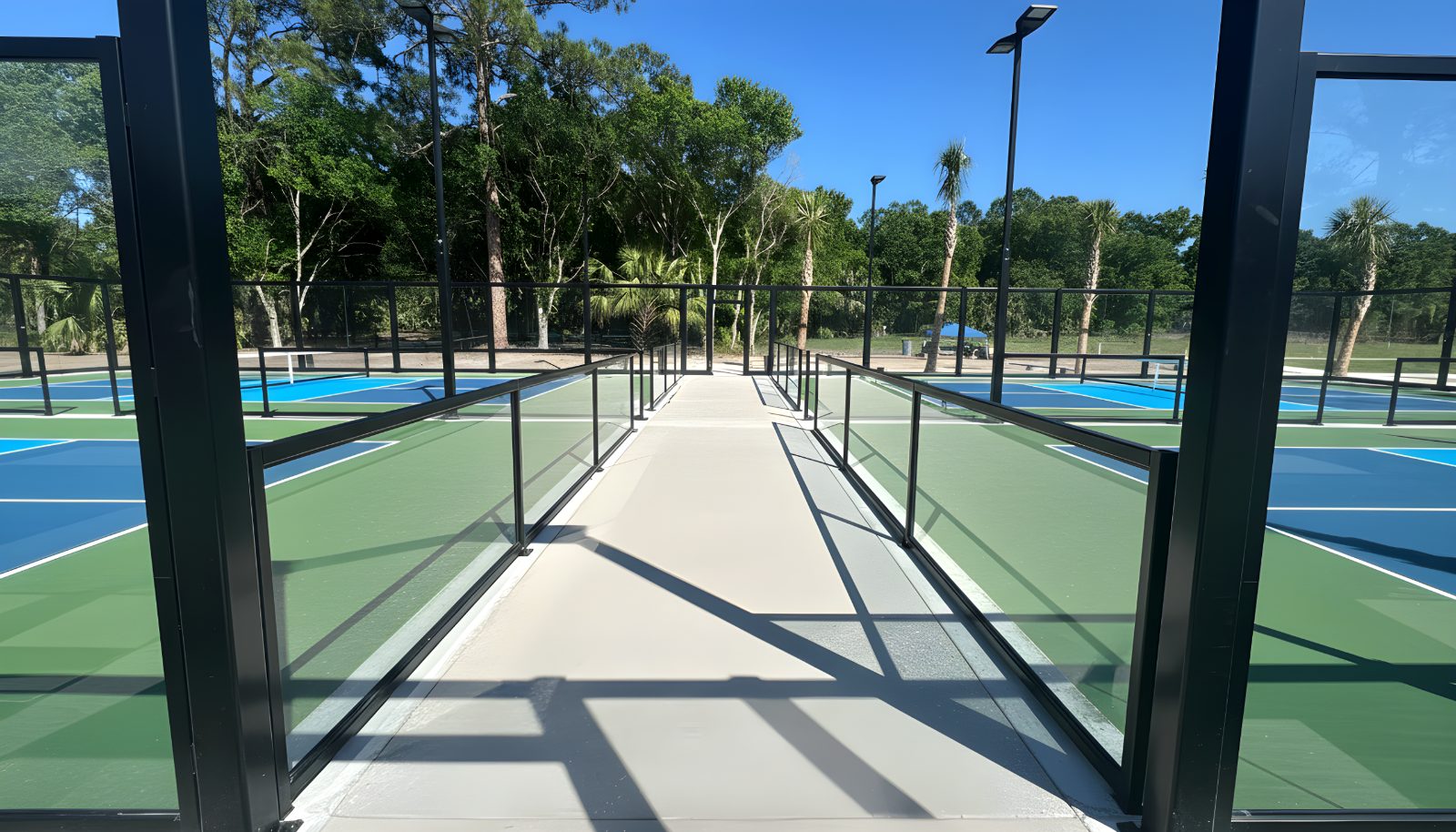
PICKLEGLASS™ is rated at STC 36 and reduces pickleball noise by up to 16 dBA, experienced as up to roughly 65% quieter at the peak, per an independent environmental noise study by Trinity Consultants and Cerami Longman Lindsey (2025) tuned to the pickleball impact frequency. That data does two things in review: it answers a noise-ordinance threshold with evidence, and it allows a court to be sited closer to occupied buildings than an open court ever could, which often resolves the setback and placement objections at the same time. Review the full measurements on the sound suppression page.
04The documentation that clears review
Approval is ultimately a paperwork exercise, and the projects that move quickly are the ones whose documentation anticipates every question. A complete, professional submission signals to a reviewer that the project is engineered rather than improvised, which itself reduces friction.
PICKLETILE delivers PE-stamped structural drawings on every project, engineered to the applicable building code, with the acoustic data, wind-load engineering (up to 200 mph, ASCE 7-22), and finish specifications a reviewer needs in one coordinated package. Because a single accountable team produces the design, the engineering, and the documentation together, there are no gaps between a separate designer and the trades for a plan-checker to reject. That coordination is a meaningful part of the 100% permit success rate to date.
| Document | What it answers | Who asks for it |
|---|---|---|
| PE-stamped structural drawings | Foundation, structural, and wind-load integrity | Building department |
| Acoustic study & ratings | Measured noise reduction against an ordinance or board concern | Planning, HOA, neighbors |
| Site plan with setbacks | Property-line distances, coverage, placement | Zoning / planning |
| Lighting plan | Spillover control and dark-sky compliance | Planning, neighbors |
| Finish & enclosure spec | That the amenity is permanent and architectural | HOA / architectural committee |
05A pre-submission checklist to de-risk approval
The approval is won in the weeks before the application is filed. Before you submit, confirm the project has retired the issues that cause denials: an acoustic strategy with measured data rather than a promise; a site plan that respects setbacks and uses the enclosure’s acoustic performance to justify placement; PE-stamped structural and electrical drawings; a lighting plan that controls spillover; and an enclosure that a board will read as architecture. Engaging an infrastructure partner who has cleared these reviews before, and who produces all of this documentation as one coordinated submission, is the single highest-leverage decision in the entire process.
- Noise drives most denials. An acoustic-rated enclosure with measured data (STC 36, up to 16 dBA, up to ~65% quieter) is what converts a contested court into an approvable one.
- Know your reviewer. Municipal review wants code-stamped documentation; an HOA or board wants a quiet, permanent, architectural amenity. Prepare for the track you face.
- Documentation wins. PE-stamped drawings, acoustic data, setback and lighting plans, and a finish spec, delivered as one coordinated package, answer the reviewer before they object.
- De-risk before you submit. A single accountable partner with a 100% permit success rate to date retires the issues that cause rejection.
FAQFrequently asked questions
Do you need a permit to build a pickleball court?
In most jurisdictions, yes. A court and its enclosure are typically treated as an accessory structure, which can require a building permit for the structural and electrical work and zoning review for setbacks, lot coverage, height, and lighting. Some locations also require a special or conditional use permit. The exact requirements vary by municipality, which is why a code-referenced, PE-stamped submission matters.
Why do pickleball court applications get denied?
The most common reason is noise. Pickleball’s impact sound concentrates near 1,600 Hz and provokes neighbor objections and board hesitation when a court is proposed near occupied buildings. Other frequent issues are setback violations, enclosure or lighting height, and stormwater or coverage limits. Most of these are solvable in the plans before submission rather than after a denial.
How do you get a pickleball court approved by an HOA?
An HOA or architectural committee weighs aesthetics, neighbor impact, and precedent more than code detail. The approval case rests on showing the amenity will be permanent and architectural rather than industrial, and that it will not generate complaints. An acoustic-rated structural glass enclosure with measured noise data addresses both concerns directly, where a chain-link enclosure tends to invite a denial.
How do noise ordinances affect a pickleball court?
Many jurisdictions evaluate a court against a measurable decibel standard at the property line, and noise complaints can lead to restricted hours or use restrictions even after a court is built. An acoustic-rated enclosure that documents real reduction, PICKLEGLASS™ reduces noise up to 16 dBA, lets you meet a threshold with evidence and site the court closer to buildings than an open court allows.
How far from a property line does a court need to be?
Setback distances are set by local zoning and vary widely, and noise concerns often push reviewers to want even more separation than the code minimum. An acoustic enclosure changes this: by reducing the sound that reaches the property line, it frequently allows a court to be placed closer to a boundary or a building than an open court would be permitted, resolving the setback objection through engineering rather than distance.
What documents do I need to submit for approval?
A review-ready submission generally includes PE-stamped structural drawings, a site plan showing setbacks and coverage, an electrical and lighting plan addressing spillover, acoustic ratings or a study, and an enclosure and finish specification. PICKLETILE produces all of this as one coordinated package, which is part of why submitted projects have cleared review at a 100% rate to date.