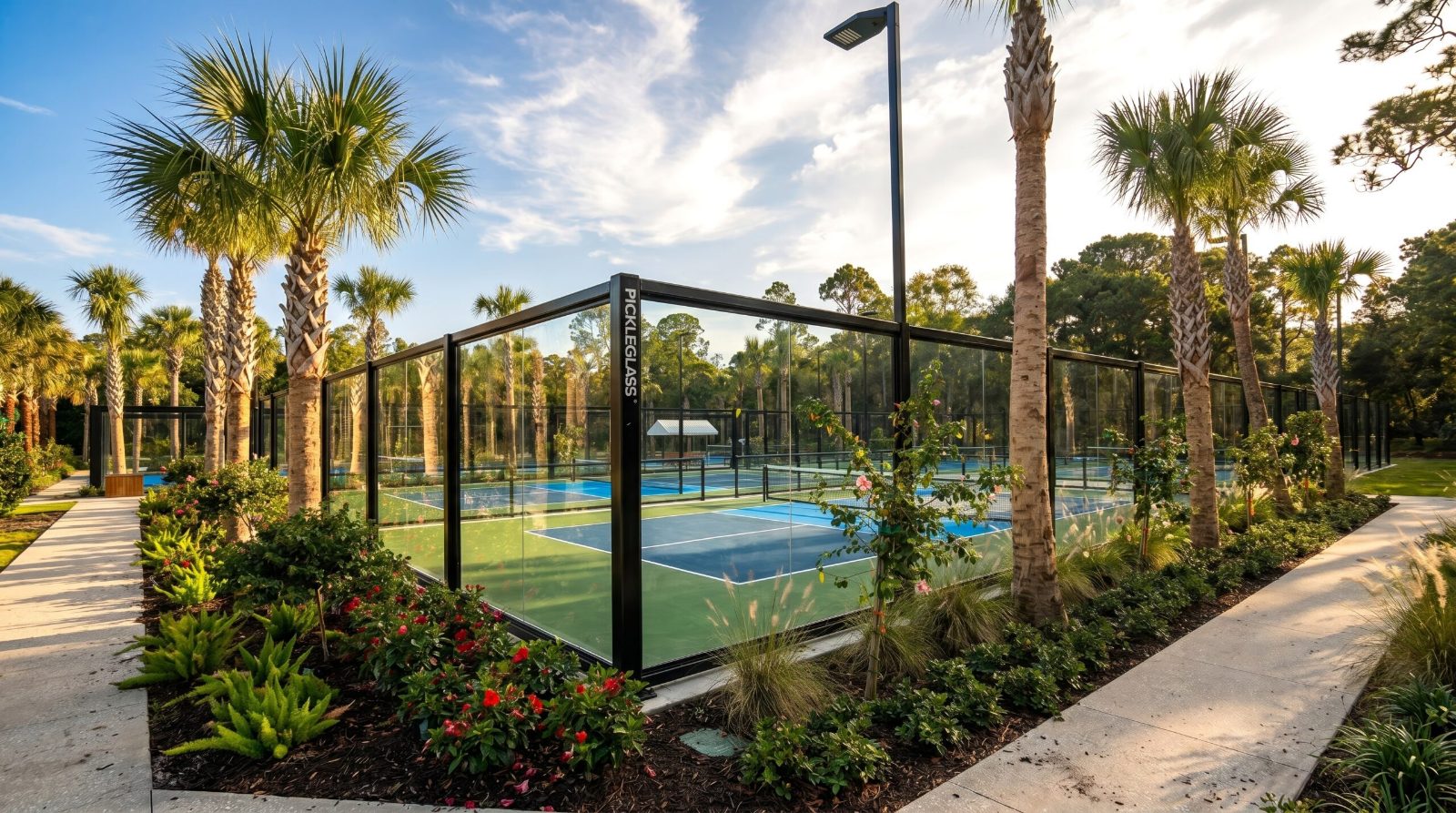
Acoustic planning for a residential court starts before the court is placed, and it is governed by one fact: the pickleball impact sound concentrates near 1,600 Hz, a sharp, repetitive frequency that ordinary distance and standard barriers do not control. The reliable approach is to design for that frequency with an acoustic-rated enclosure, site the court against the nearest noise-sensitive receptor rather than the property as a whole, and measure the result against the local nighttime ambient and any dBA ordinance. Plan around the 1,600 Hz problem and the court runs full hours without complaints. Ignore it and no setback will save the project.
01Why pickleball noise is a different problem than you think
Most owners assume court noise behaves like traffic or HVAC: a steady hum that fades with distance. Pickleball does not. The sound is impulsive, a hard, repetitive “pop” from a rigid paddle striking a hard ball, and its energy concentrates near 1,600 Hz. That matters for two reasons. First, the human ear is unusually sensitive in that range, so the sound is perceived as more intrusive than its raw decibel reading suggests. Second, impulsive high-frequency sound is exactly what people report as annoying, which is why pickleball generates complaints at distances where tennis would not.
This is the planning insight that separates a court that survives from one that gets restricted: you are not designing to reduce a general noise level, you are designing to control a specific, annoying frequency at a specific receiving property. A plan that does not name the receptor and the frequency is not an acoustic plan.
02The metrics that actually matter
Three numbers carry an acoustic plan, and confusing them is where decisions go wrong.
STC (Sound Transmission Class) rates how well a barrier blocks sound passing through it. A higher STC means more of the sound is stopped at the barrier rather than passing to the other side. dBA is the loudness at the receiving location, weighted to how the ear actually hears. Ambient is the existing background level at that receptor, and it is the baseline every ordinance and every neighbor judges against. A court is acceptable when its contribution sits at or near the existing ambient at the nearest home, not when it hits some abstract target.
PICKLEGLASS™ is rated at STC 36 and reduces perceived noise by up to 16 dBA, experienced as up to roughly 65% quieter at the peak. Those figures come from an independent environmental noise study by Trinity Consultants and Cerami Longman Lindsey (2025), tuned specifically to the pickleball impact frequency rather than to general noise.
Distance to the receptor
Measured to the nearest noise-sensitive window or patio, not the property center. Helps, but falls off slowly and is rarely enough alone.
Site planningBarrier mass & rating
A rated barrier (STC 36) stops sound at the source side. Mass and a sealed system, not height alone, do the work.
EnclosureLine of sight
If the receptor can see the paddle contact point, it can hear it. The barrier has to break the sight line to the court surface.
GeometryReflective surfaces
Nearby hard walls and hardscape bounce the 1,600 Hz pop back toward homes. Account for what is around the court, not just the court.
Surroundings03Why distance and standard barriers fall short
The two most common residential fixes, “push it to the back of the lot” and “put up a tall barrier,” both underperform against impulsive high-frequency sound. Distance attenuates sound slowly in open air, so the setback required to reach a comfortable level at a nearby home is often larger than the lot allows. A standard barrier without acoustic mass and a sealed assembly reflects and leaks the frequency it is supposed to stop, and a barrier that does not break the line of sight to the contact point does little at all.
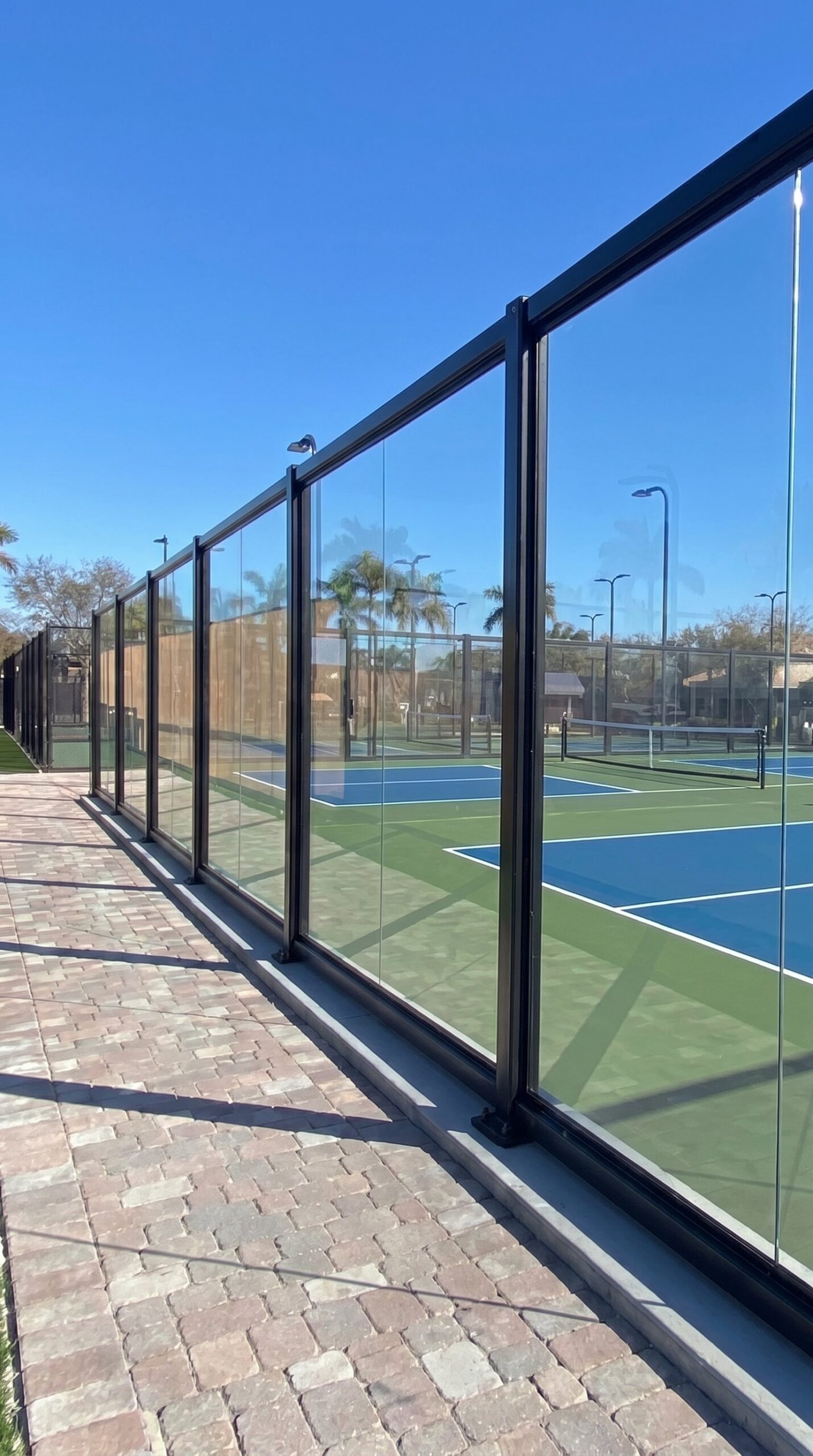
An acoustic-rated structural glass enclosure system addresses all of these at once: it provides the mass and sealed assembly to stop sound at the source side, it breaks the line of sight while preserving visibility, and at STC 36 it delivers up to 16 dBA of reduction where it is needed. The full attenuation by barrier height and distance is detailed on the sound suppression page, and the enclosure system itself is on the PICKLEGLASS™ page.
| Approach | Effect on the impact frequency | Durability |
|---|---|---|
| Setback only | Slow falloff; rarely enough on a real lot | n/a |
| Standard barrier | Reflects and leaks high frequency; little if sight line stays open | Varies |
| Acoustic tarp | Some reduction; degrades, sags, and fades over time | Replaced periodically |
| Acoustic-rated glass enclosure | STC 36, up to 16 dBA, breaks line of sight, preserves visibility | 10-year no-rust guarantee |
04The residential siting checklist
Before placement is fixed, an acoustic plan should resolve each of the following. The order matters, because each answer constrains the next.
Identify the nearest receptor. Find the closest noise-sensitive point: a bedroom window, a patio, a neighbor’s yard. Every other decision is measured to it, not to the lot line in the abstract. Establish the ambient. Record the existing background level at that receptor, ideally at the quietest relevant hours, because that is the bar. Set barrier height to exposure. Heights are specified to the exposure of each side; PICKLEGLASS™ is available in 4, 6, 8, 10, and 13 ft to match the line-of-sight break each receptor requires. Account for reflective surfaces. Map nearby hard walls and hardscape that could bounce sound back toward homes. Define hours of use. Many ordinances judge nighttime levels most strictly; the plan should match the intended hours to the levels they require.
05Ordinances, documentation, and approval
Most residential noise ordinances regulate the level at the receiving property line, often with a stricter nighttime limit, and many are written around exceeding the ambient by a set margin rather than a fixed cap. The practical consequence is that approval is won with documentation, not assertion: a measured ambient, a modeled or study-backed projection of the court’s contribution, and engineering that holds up to review. PICKLETILE delivers PE-stamped drawings on every project and reports a 100% permit success rate across submitted projects to date. In a noise-sensitive residential context, that documentation is the difference between a court that clears review and one that becomes a dispute.
- Pickleball noise concentrates near 1,600 Hz, an impulsive frequency the ear finds intrusive. Design for the frequency, not a general level.
- Plan to the nearest receptor and the local ambient, not to the lot in the abstract or to an arbitrary target.
- Distance and height alone underperform. Control needs mass, a sealed assembly, and a broken line of sight, which is what an STC 36 enclosure delivers (up to 16 dBA, up to ~65% quieter).
- Approval is won with documentation: measured ambient, a study-backed projection, and PE-stamped drawings. PICKLETILE reports a 100% permit success rate to date.
FAQFrequently asked questions
How far should a pickleball court be from homes?
There is no universal distance, because attenuation depends on the ambient at the nearest receptor and the barrier in place. Distance alone falls off slowly against the 1,600 Hz impact sound, so the setback that would work unaided is often larger than a real lot allows. The reliable approach is to measure to the nearest noise-sensitive point and pair the available distance with an acoustic-rated enclosure rather than relying on separation alone.
Why is pickleball noise such a common complaint?
Because it is impulsive and concentrated near 1,600 Hz, a frequency the human ear is unusually sensitive to. The repetitive “pop” is perceived as more intrusive than its raw decibel level suggests and carries to homes at distances where steadier sounds would not, which is why it draws complaints that tennis on the same site would not.
Can court noise actually be controlled near homes?
Yes, when the plan addresses the impact frequency directly. An acoustic-rated structural glass enclosure system provides the mass and sealed assembly to stop sound at the source side and breaks the line of sight to the contact point. PICKLEGLASS is rated at STC 36 and reduces noise by up to 16 dBA, experienced as up to roughly 65% quieter at the peak, per an independent 2025 study tuned to the pickleball frequency.
What is STC 36, in plain terms?
STC, or Sound Transmission Class, rates how well a barrier blocks sound passing through it; a higher number means more is stopped. STC 36 is a lab-rated figure for the PICKLEGLASS enclosure. It describes the barrier’s blocking performance, which combines with distance and line of sight to determine the actual reduction at a neighbor’s home.
Does barrier height alone solve it?
No. Height matters only to the extent it breaks the line of sight from the receptor to the contact point, and a tall barrier without acoustic mass and a sealed assembly will still reflect and leak the high-frequency sound. Control comes from mass, a sealed system, and the right height for each side’s exposure, which is why heights are specified per exposure (4, 6, 8, 10, and 13 ft).
What do noise ordinances usually require?
Most regulate the level at the receiving property line, frequently with a stricter nighttime limit, and many are framed as a margin above the existing ambient rather than a fixed cap. Approval typically requires a measured ambient, a study-backed projection of the court’s contribution, and engineering that survives review, which is why PE-stamped drawings and a documented acoustic basis matter.