The cost of a covered pickleball court is driven by five things: the number of courts under one structure, the clear span required, the site’s wind and snow loads, the foundation and soil conditions, and the grade of membrane and steel specified. There is no honest flat price because each of these changes per site. The more useful question is total cost of ownership: a permanent PTFE canopy is a single capital investment engineered for 30+ years, while shade structures are typically replaced every 7 to 20 years.
01Why there is no single price
Anyone who quotes a covered court “from one flat number” is either guessing or selling a one-size kit that ignores your site. A canopy is a permanent, engineered building structure, and its cost is set by the loads it has to carry and the ground it stands on, not by a catalog page. Two facilities with the same number of courts can carry very different costs because one sits on stable soil in a mild climate and the other faces high snow load on poor soil near the coast.
That is not evasion; it is engineering honesty. A figure given before a site is understood is a figure that will change. The productive move is to understand the drivers, so that when you do get a scoped number, you know what is behind it and can compare proposals on the same terms.
02The five things that move the number
Almost every dollar in a covered court traces back to five drivers. Understanding them lets you read any proposal and see where the cost actually lives.
Court count and layout. Covering four courts under one structure is not four times the cost of one; structure is shared, but a larger footprint needs more steel and a longer membrane. Clear span. The distance the roof crosses with no interior columns drives the structural demand sharply, and tennis spans wider than pickleball, so a multi-sport facility costs more than a pickleball-only one. Site wind and snow loads. A canopy is engineered to site-specific loads; high-wind coastal zones and heavy-snow climates require more robust members, anchorage, and pretensioning. Foundation and geotechnical conditions. Soil bearing, settlement risk, and uplift resistance all set how much foundation work the structure needs; poor soil costs more before anything goes vertical. Membrane and steel grade. A PTFE membrane on a hot-dip galvanized frame engineered for 30+ years carries a different cost, and a different service life, than a shade-cloth kit.
| Driver | What it controls | Why it moves cost |
|---|---|---|
| Court count and layout | Overall footprint | More area means more steel and membrane, though structure is shared |
| Clear span | Column-free distance | Wider spans need heavier members; tennis spans wider than pickleball |
| Wind and snow loads | Structural demand | Site-specific loads size the frame, anchorage, and pretensioning |
| Foundation and geotech | What goes in the ground | Soil bearing, settlement, and uplift set the foundation scope |
| Membrane and steel grade | Service life and quality | PTFE on galvanized steel is engineered for decades, not seasons |
03Upfront price vs lifecycle cost
The mistake that costs facilities the most money is comparing structures on day-one price alone. Upfront price is what a structure costs to install. Lifecycle cost, or total cost of ownership, is what it costs to own over the years you actually keep it: install, plus maintenance, plus the replacements you will buy when a short-life cover wears out. Those are very different numbers, and they often rank options in the opposite order.
A PTFE system carries a higher upfront cost than PVC or shade cloth, the strategy is honest about that, but it is engineered for a 30+ year design life with a self-cleaning surface that needs almost no maintenance. A shade cloth wins on install price and then keeps charging: cleaning, fading, sagging, and a full replacement typically inside 7 to 12 years. Measured over the horizon a serious facility actually plans around, the cheapest option to install is frequently the most expensive to own.
04Buy once vs the replacement cycle
The clearest way to think about canopy cost is to pick an ownership window, say 30 years, and ask how many times you will pay. A permanent PTFE canopy is engineered to be bought once across that window. A shade cloth at roughly 7 to 12 years of service life is bought two to three times in the same period, and a PVC membrane at roughly 15 to 20 years is bought roughly twice. Each replacement is not just new fabric; it is fresh engineering, mobilization, removal, and downtime where the courts are out of play.
This is why the permanence framing is a financial argument, not a slogan. The decision is not “expensive canopy versus cheap canopy.” It is “one engineered structure versus a recurring line item that comes back every several years.” For the ownership math by buyer type, see our companion guide on whether covered courts are worth it.
Lowest install price
Permanent canopy
05How to get a real, scoped number
Because the drivers are site-specific, an accurate figure comes from an engineered scope, not a guess. That means a short conversation about your court count and sport mix, your site’s wind and snow loads, and your soil conditions, followed by a structural concept and a scoped proposal. With those inputs, the number is real and the proposal is something you can hold a comparison against, line by line.
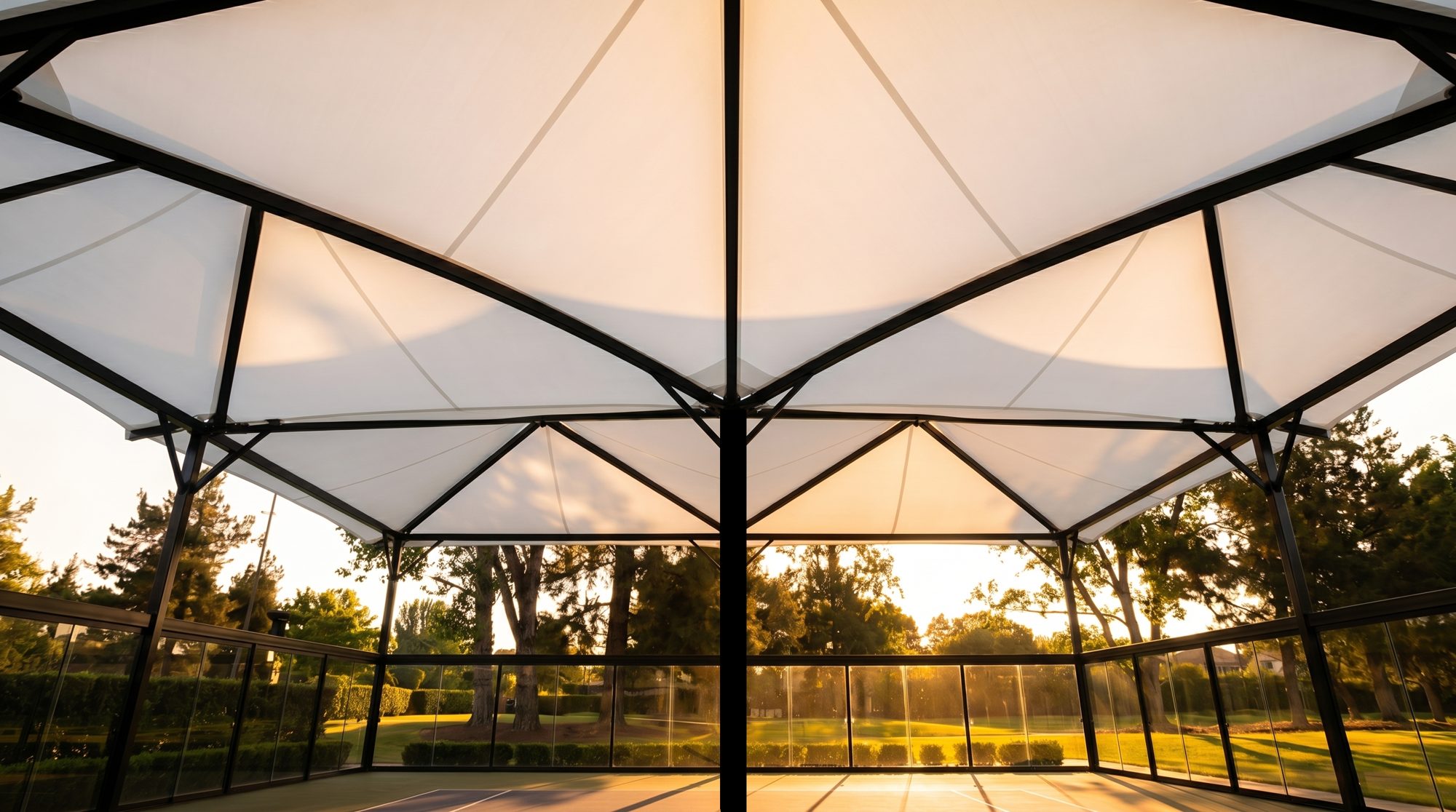
The full system is the PICKLEGLASS™ CANOPY, engineered to site-specific loads with PE-stamped structural calculations, and it completes the PICKLEGLASS™ envelope of walls and roof. The fastest path to an accurate number is to scope your site, not to chase a price that does not exist.
- Five drivers set the cost. Court count, clear span, site wind and snow loads, foundation and geotech, and membrane and steel grade.
- There is no honest flat price. Each driver changes per site, so a real number requires a scoped, engineered proposal.
- Compare lifecycle, not day-one price. The cheapest cover to install is often the most expensive to own over decades.
- Permanence is a financial argument. A PTFE canopy is engineered to be bought once, where shade structures recur every 7 to 20 years.
FAQFrequently asked questions
How much does it cost to cover a pickleball court?
There is no single flat price, because cost is driven by court count, clear span, site wind and snow loads, foundation and soil conditions, and membrane and steel grade. An accurate figure comes from a scoped, engineered proposal for your specific site.
What drives the cost of a covered pickleball court?
Five drivers: the number of courts under one structure, the clear span required, the site’s wind and snow loads, the foundation and geotechnical conditions, and the grade of membrane and steel specified. Each is site-specific, which is why prices vary.
Is a permanent canopy more expensive than shade cloth?
It carries a higher upfront cost, but lower lifecycle cost. A PTFE canopy is engineered for a 30+ year design life and bought once, while shade cloth typically needs replacement every 7 to 12 years and PVC roughly every 15 to 20, so the cheapest install is often the most expensive to own.
Why does clear span affect the price so much?
Clear span is the column-free distance the roof crosses, and it drives structural demand sharply. Wider spans need heavier steel members and more engineering, which is why a multi-sport facility covering tennis costs more than a pickleball-only structure.
How do I get an accurate price for my facility?
Through a scoped consultation that captures your court count and sport mix, your site’s wind and snow loads, and your soil conditions, followed by a structural concept and an engineered proposal with PE-stamped calculations.