A PTFE tensile membrane transmits 12 to 15% of natural light as soft, diffused daylight, giving a covered court even, glare-reduced visibility instead of harsh open-sky glare or a dark cover. Because the light is scattered across the whole membrane rather than passing through as direct sun, there are no hot spots or deep shadows, the surface that follows the ball stays evenly lit, and the daytime need for artificial lighting drops. The membrane’s high solar reflectance also reduces heat gain, so the court stays more comfortable.
01The two ways lighting goes wrong
Open-air courts and badly covered courts fail at light in opposite directions, and both hurt play. The first failure is open-sky glare: direct sun and bright sky create harsh contrast, hot spots, and moments where a player loses the ball against the light. Anyone who has tracked a lob into a low sun knows the problem; it is not a comfort nicety, it is a visibility and safety issue.
The second failure is the opposite, a dark cover. Solid roofs and dense shade cloth solve glare by blocking light, but they turn the court gloomy and force the lights on even at midday, trading one problem for another and adding an energy bill. The goal is neither extreme. The right canopy gives full overhead cover while still letting controlled, even daylight reach the court.
02How a PTFE membrane diffuses daylight
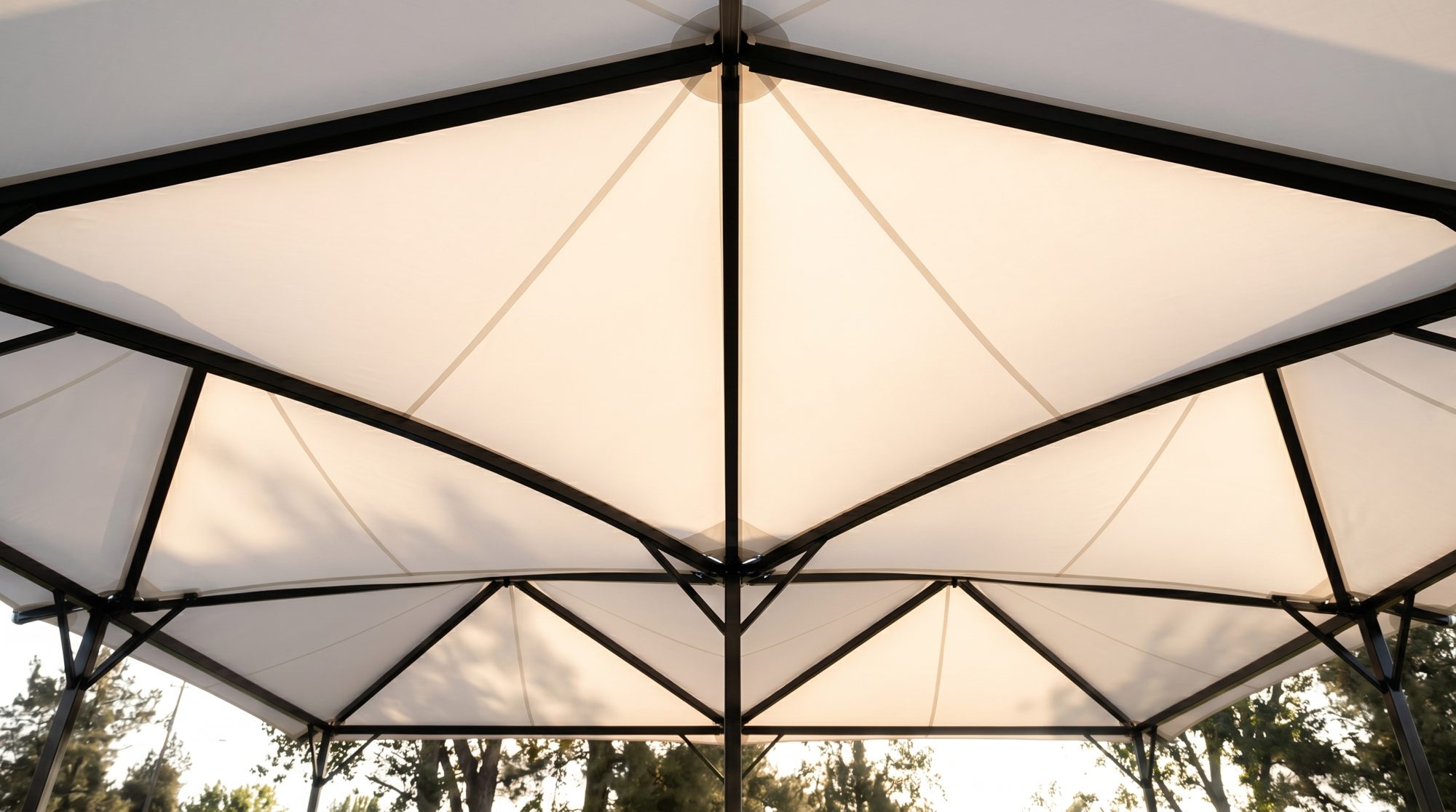
A PTFE-coated fiberglass membrane is translucent, not transparent and not opaque. It transmits 12 to 15% of natural light, and, crucially, it scatters that light as it passes through. Instead of a beam of direct sun hitting one patch of court, the entire membrane glows softly and re-emits light evenly across the whole surface below. That diffusion is the mechanism behind the quality: the same property that makes the canopy look like a luminous white ceiling is what removes glare and hot spots from the court.
The transmittance is a range because it is engineered to the application; a facility can be specified toward the brighter or softer end depending on climate and use. What stays constant is the character of the light: even, shadow-free, and glare-reduced. This is why a covered court under PTFE does not feel like being indoors with the lights off; it feels like playing under a bright, soft sky.
03What that does for players
The on-court payoff is comfort and visibility. With diffused daylight, the ball is easy to track because the light is consistent everywhere, with no bright zones and dark zones to adjust between as players move. There is no squinting into glare and no losing the ball against a hot patch of sky, which matters most on overhead shots and fast exchanges. The experience reads as premium precisely because it removes the small frustrations that uncovered courts create.
This is also why daylight quality is a desire driver, not just a technical spec. A facility selling member or guest experience is selling how the space feels, and a court bathed in soft, even daylight simply feels better to play on than one fighting glare or buried in shadow. For how that experience folds into the full case for a canopy, see our guide on whether covered courts are worth it.
The wrong extremes
Diffused daylight
04Energy, heat, and the building case
Daylight quality is not only an experience benefit; it is an operating one. Because the membrane delivers usable daylight across the court, a facility can run fewer artificial lights during daytime hours, which lowers the daytime lighting load and its energy cost over the life of the building. A covered court that needs the lights on at noon is paying twice; a PTFE court that is daylit is not.
The membrane also manages heat. PTFE has high solar reflectance, so it reflects a large share of solar energy rather than absorbing and re-radiating it downward, which reduces heat gain under the canopy and keeps the court more comfortable in hot conditions. So the same surface does three things at once: it diffuses light for visibility, cuts daytime lighting cost, and reduces heat gain for comfort. That combination is why membrane light quality is a real engineering advantage, captured in the full PICKLEGLASS™ CANOPY system that completes the PICKLEGLASS™ envelope.
- Avoid both extremes. Open-sky glare and dark covers each hurt play; the goal is even, controlled daylight.
- 12 to 15% diffused daylight. PTFE scatters light evenly across the court, removing glare, hot spots, and deep shadow.
- Better visibility and comfort. Consistent light makes the ball easy to track and the space feel premium.
- Lower energy and heat. Daylight cuts the daytime lighting load, and high solar reflectance reduces heat gain under the canopy.
FAQFrequently asked questions
Do covered courts get enough light to play?
Yes. A PTFE membrane transmits 12 to 15% of natural light as soft, diffused daylight, so a covered court is evenly and brightly lit during the day without glare or the need for artificial lighting, rather than being dark like a solid-roofed space.
How does a PTFE canopy reduce glare?
The translucent membrane scatters light as it passes through, so it glows evenly across its whole surface instead of letting direct sun through in beams. That diffusion eliminates the hot spots and harsh contrast that cause glare on open-air courts.
What does diffused daylight do for players?
It makes the light consistent everywhere on the court, so the ball is easy to track with no bright or dark zones to adjust between, no squinting into glare, and no losing the ball against the sky, especially on overhead shots and fast exchanges.
Does a daylit canopy save on energy?
Yes. Because the membrane delivers usable daylight across the court, a facility can run fewer artificial lights during daytime hours, lowering the daytime lighting load and its energy cost over the life of the building.
Does the canopy reduce heat under the court?
It helps. PTFE has high solar reflectance, so it reflects a large share of solar energy rather than absorbing and re-radiating it downward, which reduces heat gain under the canopy and keeps the court more comfortable in hot conditions.